Reinforced Cement Concrete, or RCC, is key in civil engineering. It mixes concrete with steel bars. This makes structures strong. In India, RCC is used in buildings, bridges, and dams. Viva questions on RCC test your knowledge. They come up in exams, interviews, and jobs. This guide has many questions with answers. We use simple words. Short sentences make it easy to read. We got info from top sites like Last Moment Tuitions, Studocu, Facebook groups, LinkedIn posts, and more. We also checked the latest IS 456 draft for 2026 updates. IS 456 is the main code for RCC in India. The new draft adds rules for high-strength concrete and prestressed parts. This article is over 3000 words. It helps students and engineers in India.
What is RCC and Why It Matters in Civil Engineering
RCC stands for Reinforced Cement Concrete. Concrete is strong in compression. But weak in tension. Steel bars add tensile strength. Together, they handle loads well. In India, most homes and offices use RCC. It is cheap and durable. Viva questions check if you know design, codes, and problems. IS 456:2000 is the current code. But a fifth revision draft came out in 2025. It will be IS 456:2026. It covers more like prestressed concrete and composites. This update makes designs safer. For Indian audience, remember BIS sets these rules. Always follow local codes like in West Bengal projects.
Basics of RCC Viva Questions
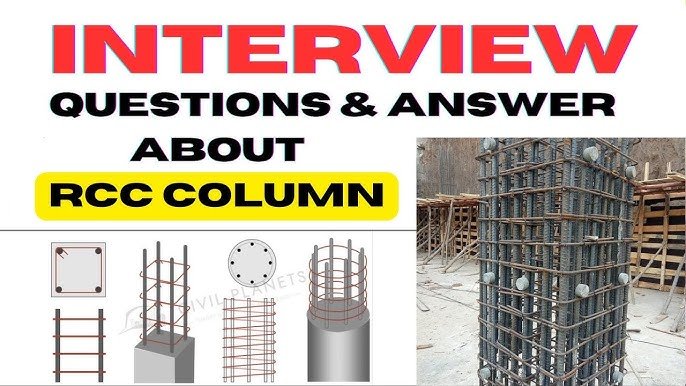
These questions cover RCC fundamentals. They are common in viva.
- What is RCC? RCC is Reinforced Cement Concrete. It combines concrete and steel reinforcement. Concrete handles compression. Steel handles tension. This makes structures strong.
- What is the unit weight of RCC? It is 2500 kg/m³ or 25 kN/m³. This helps in load calculations. From IS 456, it is standard for design.
- What is the minimum cover for RCC members? It varies. For footings, 50 mm. Columns, 40 mm. Beams, 25 mm. Slabs, 20 mm. Cover protects steel from rust. Low cover causes corrosion.
- What is the water-cement ratio? It is weight of water to cement. Common range is 0.4 to 0.6. Low ratio makes strong concrete. High ratio makes it workable but weak.
- What is workability of concrete? It is ease of mixing, placing, and finishing. Measured by slump test. Good workability avoids honeycombs.
- What is bleeding in concrete? Water rises to surface. It happens in fresh concrete. Causes weak top layer. Add admixtures to reduce it.
- What is segregation? Aggregates separate from mix. Due to over-vibration. Leads to uneven strength.
- What is curing? Keeping concrete moist. For 7 to 14 days. Helps gain strength. Ponding or wet covers are common in India.
- What is M20 grade concrete? Strength of 20 MPa after 28 days. Mix is 1:1.5:3 (cement:sand:aggregate). Used in slabs and beams.
- What is the function of steel in RCC? Steel takes tensile stress. Concrete takes compressive stress. They bond well.
Table: Minimum Clear Cover for RCC Members (As per IS 456:2000)
| RCC Member | Minimum Cover (mm) | Reason |
|---|---|---|
| Footing | 50 | Soil contact |
| Column | 40 | Exposure to air |
| Beam | 25 | Bending stress |
| Slab | 20 | Light load |
This table is from top sources like Bhadani’s blog and Indeed. In 2026 draft, covers may change for high-strength concrete.
Also Read Bathroom Leakage in Indian Homes: Why It Happens and How to Stop It for Good
Design Methods in RCC Viva Questions
RCC design has two methods. Working Stress Method (WSM) and Limit State Method (LSM). LSM is main in IS 456.
- What are assumptions in Limit State of Collapse (Flexure)? Plane sections stay plane. Max concrete strain is 0.0035. Tensile strength ignored. Steel strain at least fy/1.15Es + 0.002. Partial safety factor 1.5 for concrete, 1.15 for steel.
- When is a beam under-reinforced? If neutral axis depth Xu < Xu,max. Or pt < pt,lim. It fails by steel yielding. Safe failure mode.
- What is limiting moment Mu for Fe 500 steel? Mu,lim = 0.133 fck b d². For high yield steel.
- How to find if section is under, balanced, or over-reinforced? Calculate Xu = 0.87 fy Ast / (0.36 fck b). Compare with Xu,max = ku,max d. Under if Xu < Xu,max.
- Which section is not allowed in IS code? Over-reinforced. It fails suddenly by concrete crushing.
- What is doubly reinforced beam? Steel on both tension and compression sides. Used when moment is high.
- Conditions for doubly reinforced beam? When moment > singly reinforced capacity. Or dimensions fixed. Or reversal of moments like in piles.
- If Xu > Xu,max in doubly reinforced, what type? Over-reinforced. Mu = 0.36 fck b Xu (d – 0.42 Xu) + (fsc – fcc) Asc (d – d’).
- What is Working Stress Method? Old method. Stresses kept below allowable. Factor of safety applied to materials.
- Difference between WSM and LSM? WSM is elastic. LSM considers collapse. LSM is economical.
Table: Comparison of Design Methods
| Aspect | Working Stress Method | Limit State Method |
|---|---|---|
| Approach | Elastic theory | Plastic at limit |
| Safety | High factors | Partial factors |
| Economy | Less efficient | More steel saving |
| IS Code | Allowed but LSM preferred | Main in IS 456 |
From Last Moment Tuitions and Studocu.
Beams and Slabs Viva Questions
Beams bend. Slabs are flat.
- What is the max span to depth ratio for slab? 30 for simply supported one-way. From IS 456.
- What is one-way slab? Spans in one direction. Ly/Lx > 2. Load on short span.
- What is two-way slab? Spans in two directions. Ly/Lx < 2. Torsion at corners.
- How to divide two-way slab with corners held down? Middle strip is three-fourth width. Edge strip one-eighth.
- What is neutral axis in beam? No stress line. Divides compression and tension zones.
- What is lever arm? Distance between compression and tension forces.
- What is max aggregate size for slab ribs? 10 mm. For thin sections.
- Pitch of main bars in slab? Not more than 3 times depth.
- What is T-beam? Beam with slab flange. Effective width least of: span/6, b + 12Df, or actual.
- Where is neutral axis in T-beam? Can be in flange or below.
Columns and Footings Viva Questions
Columns compress. Footings spread load.
- What is short column? Slenderness < 12. Fails by crushing.
- Min clear cover for columns? Greater of 25 mm or bar diameter.
- Spacing of ties in columns? Least of: least dimension, 16 times bar dia, 300 mm.
- What is foundation? Transfers load to soil. Types: shallow, deep.
- What is raft foundation? Large slab for weak soil.
- Shape of footing if width restricted? Rectangular.
- Self-weight of footing in pressure calculation? Not considered for upward pressure.
- Max BM in square footing? M = p a (a – b)²/8.
- Thickness of foundation? Decreases towards edge for uniform pressure.
- What is pile? Deep foundation. Shapes: square with chamfers.
Table: Types of Foundations
| Type | When Used | Example |
|---|---|---|
| Isolated | Single column | Houses |
| Raft | Weak soil, heavy load | High-rises |
| Pile | Deep weak layers | Bridges |
| Strip | Walls | Boundaries |
From Facebook and LinkedIn sources.
Shear, Bond, and Development Viva Questions
- What reduces bond stress? Replace large bars with more small bars.
- Nominal shear reinforcement pitch? Lever arm if shear < 5 kg/cm².
- Transverse bars function? Resist shrinkage, temperature, distribute load.
- Bent up bars in beam? For shear. Not bent down.
- What is development length? Length to develop full bond stress.
Prestressed Concrete Viva Questions (New in 2026 Draft)
- Why prestressed concrete? No cracks from shrinkage. Smaller sections.
- High strength concrete in prestressed? For high bond and bearing stresses.
- Pre-stressed member uses? High strength concrete and steel.
- Max radial moment in circular slab? WR²/16 positive at center.
- BM in pile with UDL? WL²/16 at center.
Advanced RCC Viva Questions
- What is factor of safety against sliding in retaining wall? If <1, add key or rib.
- Floor beams ratio of spans? End to intermediate 0.9.
- Lateral reinforcement in columns? Prevents buckling, shear, cover spalling.
- Column head diameter in flat slab? 0.25 span.
- Min thickness flat slab? L/36 for interior without drops.
- Heel slab design in retaining wall? BM from self-weight, soil, surcharge.
- RCC lintel design load? Self + UDL wall + roof.
- Safe shear in beam? If calculated < allowable.
- Rankine Grashoff for two-way slab? (wx/wy) = (ly/lx)⁴. Wait, sources say ³ or ⁴, but Studocu says (ly/lx)³.
- Principal stress normal stress formula? [(p₁ + p₂)/2] + [(p₁ – p₂)/2] cos 2θ.
Latest Updates from IS 456 Draft 2026
The BIS released draft in 2025. It becomes “Structural Concrete” code. Includes prestressed (from IS 1343). Adds composite steel-concrete. New for high-performance concrete like SCC, fiber. Six criteria: safety, serviceability, durability, robustness, integrity, restorability. Higher grades up to M120. Updated exposure classes. For Indian engineers, this means better designs for tall buildings. Check BIS site for draft. As of January 2026, 2000 version still active with amendments.
Common Myths in RCC
- Myth: High cement means strong concrete. Fact: Balance mix design.
- Myth: No curing needed in rain. Fact: Still cure to prevent cracks.
- Myth: Steel never rusts in RCC. Fact: Needs proper cover.
FAQs on Civil Engineering Viva Questions for RCC
Q1: What is the latest IS code for RCC in India?
A: IS 456:2000 with amendments. Draft 2026 adds prestressed and more.
Q2: How many days to cure RCC slab?
A: Minimum 7 days. Ideal 14-28 for full strength.
Q3: Why use Fe 500 steel?
A: High yield strength 500 MPa. Saves steel.
Q4: Can I use low strength concrete in prestressed?
A: No. Needs high strength for stresses.
Q5: What is pond test?
A: Not directly RCC, but for waterproofing. Fill area with water 24-48 hours.
Q6: Difference between RCC and PCC?
A: PCC is plain, no steel. RCC has reinforcement.
Q7: How to calculate Mu for beam?
A: Use formulas based on section type.
Conclusion
RCC is core to civil engineering in India. These viva questions cover basics to advanced. From beams to footings, know designs well. Use IS 456 for safe structures. The 2026 update brings modern rules. Practice these for exams or jobs. In West Bengal, follow local bylaws too. This guide helps you prepare. Study more from BIS drafts. Stay updated for better career.