Shear walls are critical structural elements in modern buildings. They resist lateral forces caused by wind and earthquakes. When designed and detailed well, shear walls ensure stability, reduce building sway, and protect occupants. This article explains everything you need to know about shear walls—types, design principles, detailing requirements, advantages, limitations, and practical guidance for Indian construction projects.
Written in simple English and short sentences, this guide is ideal for civil engineering students, site engineers, contractors, and building professionals in India. It uses relevant keywords like shear walls, RC shear wall design, seismic shear wall detailing, shear wall construction India, and coupled shear wall benefits to help with search engine visibility.
What Is a Shear Wall?
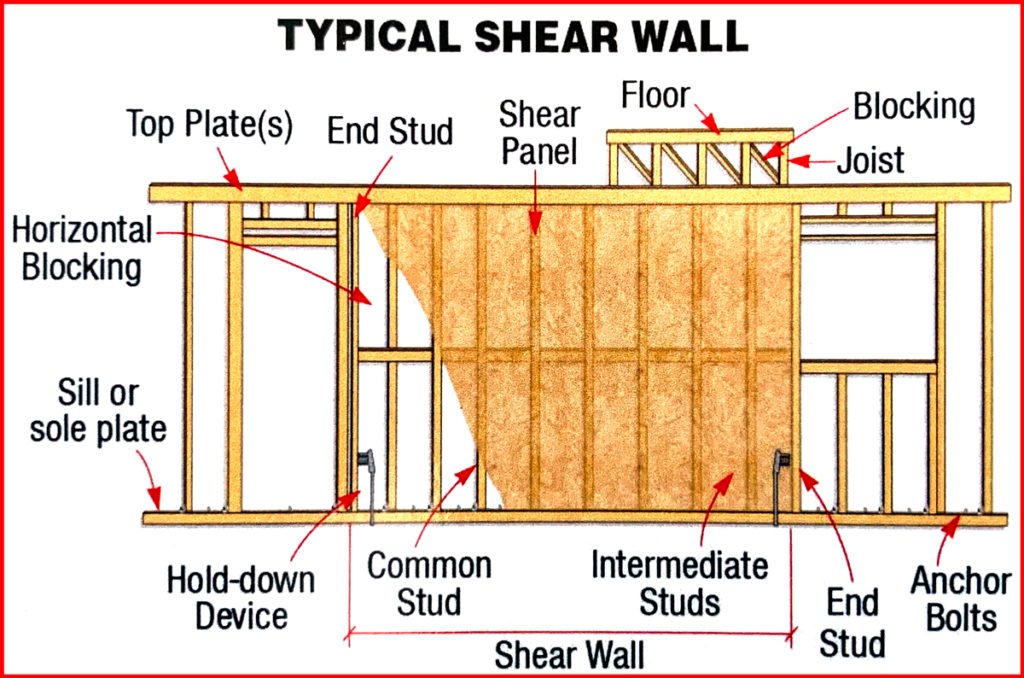
A shear wall is a vertical structural member made of reinforced concrete, masonry, steel, or composite materials. It extends along the height of a building and is connected to slabs and foundations. The primary purpose of a shear wall is to resist lateral loads such as wind, seismic forces, and sometimes horizontal earth pressure.
Unlike ordinary structural walls, shear walls are heavily reinforced to control bending and shear. They form a rigid spine in tall buildings and help maintain the building’s shape under load. In Indian construction, shear walls are widely used in apartment blocks, commercial towers, hospitals, and infrastructure where safety, vibration control, and drift control matter.
Why Use Shear Walls?
Shear walls offer many advantages in building design and construction:
- High Lateral Stiffness: They limit lateral movement (story drift) and vibrations, improving occupant comfort and structural safety.
- Good Seismic Performance: Shear walls provide well-defined load paths for earthquake forces, reducing risk of collapse or heavy damage.
- Space Efficiency: Compared to braced frames or heavy beams, shear walls can be integrated into the building core or along perimeter walls, saving usable floor space.
- Ease of Construction: Reinforced concrete shear walls can be constructed using conventional formwork, speeding up building schedules.
- Versatility: They can combine gravity load support and lateral load resistance, making them efficient structural elements.
These features make shear walls a preferred lateral force-resisting system, especially in high-rise or earthquake-prone regions of India.
Types of Shear Walls
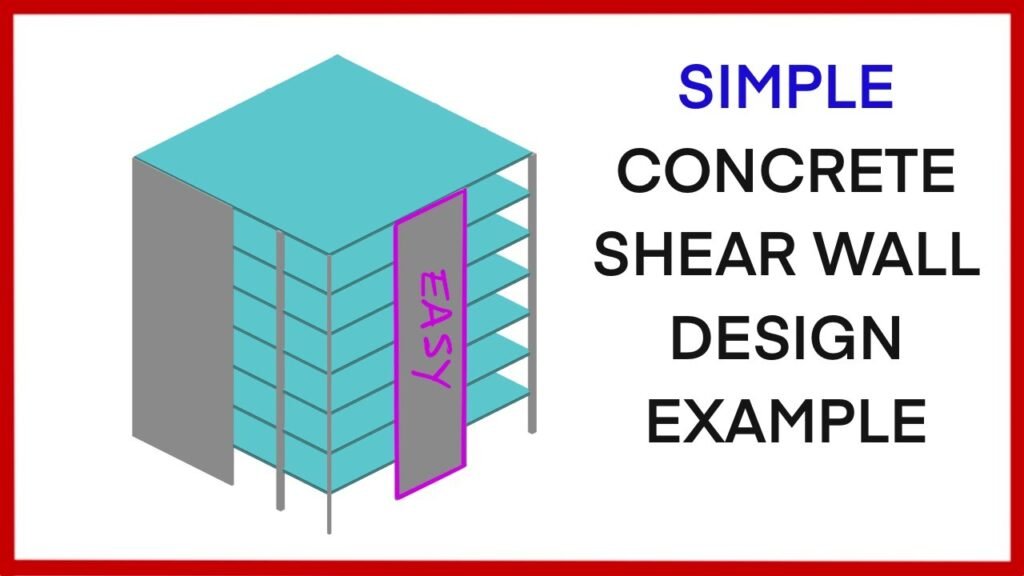
Shear walls are classified by their geometry, reinforcement layout, coupling mechanism, or material type. Common types include:
1. Cantilever Shear Wall
This is a single vertical wall fixed at the base, acting like a cantilever beam. It resists lateral loads by bending and shear. Good for low- to mid-rise buildings where a single wall can provide adequate stiffness.
2. Coupled Shear Wall
Two or more walls are connected by beams called coupling beams. These walls act together under load. Coupled systems have higher moment capacity and better energy dissipation under earthquakes. The coupling beams become energy-dissipating zones.
3. Flanged (T- or L-Shaped) Shear Wall
Walls with flanges (wings) on one or both sides increase stiffness and torsional resistance. Useful at building corners or where architectural layout demands a wing.
4. Infilled Shear Wall or Masonry Shear Wall
In a frame structure, masonry infill or reinforced walls act as shear walls. Careful detailing and modelling are required. Suitable for low-rise residential buildings in India, especially with reinforced masonry.
5. Steel or Composite Shear Wall
Made of steel plates or composite steel-concrete panels. Best for very tall buildings, fast erection, or when high seismic zones apply. More expensive but offer high performance.
Table — Shear Wall Types Overview
| Type | Typical Use | Benefits | Considerations |
|---|---|---|---|
| Cantilever Wall | Low to mid-rise buildings | Simple, effective | May need larger thickness for tall buildings |
| Coupled Wall | High-rise in seismic zones | High stiffness & energy dissipation | Coupling beams require special detailing |
| Flanged Wall | Building cores, edge locations | Good torsional resistance | Flanges reduce usable floor space |
| Masonry/Infill Wall | Low-rise, residential | Cost-effective | Lower ductility, careful modelling needed |
| Steel/Composite Wall | Premium tall buildings | Lightweight, fast installation | Higher material & fabrication cost |
Also Read SOR in Construction: Understanding and Documenting Construction Rates
Structural Behaviour and Load Transfer
Shear walls transfer lateral loads to the foundation through a clear load path. Key forces and behaviours include:
- Shear Capacity: The wall must resist horizontal shear forces without brittle diagonal cracking.
- Flexural Capacity: Because walls bend under lateral load, vertical reinforcement resists bending moments.
- Drift Control: Serviceability often requires limiting story drift to L/250 or L/300 (where L is story height).
- Ductility: Under seismic loading, walls must yield in a ductile manner rather than fail suddenly. Detailed reinforcement and confinement are essential.
- Torsional Behaviour: In asymmetrical layouts, walls must resist torsion. Flanged walls or walls grouped to form a core help address this.
In design, engineers analyse shear walls in 2D or 3D models. The wall may be modelled as a shell (plate) element or as equivalent frame elements. Shear stress (v), bending moment (M), shear force (V) and axial load (N) are computed. The wall must satisfy code limits for each. Engineering studies show well-detailed shear walls provide excellent seismic resilience.
Indian Code Guidance and Detailing Requirements
In India, shear wall design follows important code standards:
- IS 456 (Plain and Reinforced Concrete) for general design requirements.
- IS 13920 (Ductile Detailing of Reinforced Concrete Structures Subjected to Seismic Forces) for detailing in earthquake zones.
- IS 1893 (Criteria for Earthquake Resistant Design) for seismic loads.
- IS 875 (Codes for Wind Loads) for wind design.
Detailed rules in IS 13920 include minimum reinforcement ratios, boundary element reinforcement (e.g., vertical bars at wall edges), stirrups/ties spacing, coupling beam detailing, and openings in walls. These rules ensure the wall is capable of ductile behaviour and energy dissipation under earthquake loads.
Design Steps for Shear Walls
Key steps in designing shear walls include:
- Determine loads: Gravity loads, seismic loads, wind loads, axial loads from columns.
- Select wall layout early: Place walls symmetrically about centre of mass where possible to avoid torsion.
- Preliminary sizing: Based on empirical ratios (wall area to floor area), or preliminary models.
- Perform analysis: Use frame-wall models or finite-element models to extract forces and displacements.
- Check shear and flexure: Compare shear force (V) and bending moment (M) from analysis with design capacities.
- Check drift: Ensure story drift within limits for serviceability.
- Detail reinforcement: Use IS 13920 rules for boundary elements, longitudinal and transverse reinforcement, coupling beams.
- Construct and supervise: Ensure quality of concrete, reinforcement placement, cover, curing, and formwork alignment.
- Serviceability and durability checks: Crack width, reinforcement corrosion protection, long-term deflection.
A simple reinforcement table might include:
| Parameter | Typical Value (for RC wall) |
|---|---|
| Minimum vertical reinforcement | 0.0025 to 0.005 of wall gross area |
| Minimum horizontal reinforcement | 0.002 of wall gross area |
| Minimum thickness for low-rise | 150 mm to 200 mm (depending on load) |
| Cover | 40 mm to 50 mm depending on exposure |
These are indicative. Always refer to structural engineer’s calculations and code tables.
Advantages of Shear Walls
Shear walls bring several benefits:
- Reduced lateral movement and better comfort for occupants.
- Improved seismic safety especially in high seismic zones of India (Zone IV, V).
- Efficient structural form — the wall can act as structural and architectural element (core wall, partitions).
- Faster construction using repetitive wall panels and conventional formwork.
- Better load path clarity—which simplifies design and inspection.
For Indian projects, shear walls are often the preferred system in residential towers because the wall acts as stair/lift core and reduces plan complexity.
Limitations and Challenges
Shear walls also have certain limitations:
- Architectural constraints — walls may restrict openings, views or flexibility of layouts.
- Cost of detailing and reinforcement—especially in deep or coupled walls.
- Stiffness can attract large seismic forces – if stiffness is not balanced with ductility, the design may lead to large base shear.
- Construction quality demands—poor concrete or reinforcement placement can cause brittle failures.
- Retrofitting difficulty—if shear walls were not provided in original design, adding them is difficult and costly.
Understanding these drawbacks helps the design team plan accordingly.
Practical Considerations for Indian Construction
- Place shear walls early in the architectural layout, especially at lift cores and stair shafts.
- Avoid offset walls—walls should continue from foundation to roof with minimal interruption.
- Limit large openings near the base; if needed, provide piers for structural continuity.
- Use good quality concrete (M30 or higher) and ensure cover and curing to protect reinforcement from corrosion (especially in coastal regions).
- Monitor construction joints in shear walls to avoid weak zones.
- Coordinate mechanical, electrical, plumbing services with the wall layout to avoid cutting key zones.
- Inspection of reinforcement and formwork is critical; boundary zones and coupling beams require special attention.
In India, many high-rise projects employ shear-wall systems because of these practical advantages.
Maintenance and Inspection
After construction, shear walls still need attention:
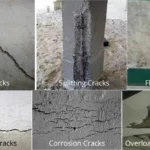
- Inspect for cracks especially near wall edges and openings.
- Check cover deterioration and pollution corrosion in exposed zones (especially coastal areas like Mumbai, Goa).
- Monitor drift or serviceability issues over time, especially if the building undergoes structural modification.
- Evaluate penetrations or modifications through walls – avoid cutting reinforcement or weakening boundaries.
- Ensure that coupling beams and boundary elements remain intact and accessible for inspection.
Good maintenance extends the reliable performance of shear walls over decades.
SEO Keywords to Integrate
Shear wall, reinforced concrete shear wall, shear wall design India, seismic shear wall detailing, coupled shear wall, shear wall vs braced frame, shear wall construction, shear wall reinforcement, shear wall benefits, shear wall types, RC core wall, building shear wall layout.
Frequently Asked Questions (FAQs)
Q1. What is the primary difference between a shear wall and a load-bearing wall?
A shear wall is specifically designed to resist lateral (horizontal) loads like wind or earthquake forces, while a load-bearing wall primarily carries vertical (gravity) loads. Shear walls have heavier reinforcement and specific detailing for shear and flexure.
Q2. Where should shear walls be placed in a building plan?
Ideally, shear walls should be near the centre of mass (core) to avoid torsion and ensure uniform stiffness. They may also be along the building perimeter or corners in symmetrical layouts.
Q3. Can a building use both shear walls and frames?
Yes. Many buildings use a hybrid system where shear walls provide core stiffness and frames handle the rest of the structure. This allows architectural flexibility with structural resilience.
Q4. How thick must a shear wall be?
There is no single value; thickness depends on building height, load, seismic zone and analysis. Typical thicknesses for residential buildings might range from 200 mm to 300 mm or more for tall structures.
Q5. Must all walls be shear walls in high-rise buildings?
No. Only selected walls may be designed as shear walls. The structural engineer identifies walls that will act as the main lateral force resisting system based on analysis and layout.
Q6. Which Indian codes apply to shear wall design and detailing?
Key codes: IS 456 (General concrete design), IS 13920 (Ductile detailing), IS 1893 (Seismic load criteria), IS 875 (Wind loads). Engineers should use the latest editions of these codes.
Q7. What happens if a shear wall is poorly constructed?
Poor construction—such as low cover, missing reinforcement, honeycombed concrete—can cause brittle failures in earthquakes or wind loads. Proper supervision and quality control are essential to ensure performance.
Conclusion
Shear walls are a highly effective and reliable solution for lateral force resistance in building construction. When well designed, detailed and constructed according to code guidelines, they provide excellent stiffness, strength and seismic resilience. In India’s seismic-prone and rapidly urbanising environment, shear wall systems are often the preferred choice for high-rise residential and commercial buildings.
The key to success lies in early planning, coordinated architecture-structure layout, attention to detailing (especially boundary elements and openings), and high quality on site. With these practices, shear wall structures deliver safety, economy and long life.