A Civil Site Engineer is one of the most crucial professionals in the construction industry. They are responsible for transforming designs and drawings into actual buildings, bridges, roads, and structures. Their main role is to supervise construction work on-site, ensuring that the project meets all technical, quality, and safety standards.
This detailed article explains the roles, duties, skills, tools, and responsibilities of a civil site engineer in India. It is written in simple English, using short sentences for better readability. It includes latest updates (2025), practical site tasks, tables, FAQs, and SEO-friendly keywords related to civil engineering jobs in India, construction site management, and civil site supervision.
What is a Civil Site Engineer?
A civil site engineer is the professional who oversees the construction process on-site. They interpret architectural and structural drawings, plan the layout of works, supervise manpower, and ensure that materials and techniques used comply with standards and specifications.
In short, they are the link between design engineers and construction teams. Without them, a project cannot move from paper to reality.
Importance of a Site Engineer in Indian Construction

India’s construction industry is booming. With rapid urbanization and infrastructure growth, there is a massive demand for qualified site engineers. Whether it’s highways, metro projects, residential apartments, or smart cities, every project needs skilled engineers to supervise execution.
A good civil site engineer helps:
- Maintain quality and safety on site.
- Prevent rework and material wastage.
- Ensure projects finish on time and within budget.
- Coordinate between clients, contractors, and workers.
In India, a site engineer’s efficiency can directly affect the profitability and reputation of a construction company.
Key Roles and Responsibilities of a Civil Site Engineer
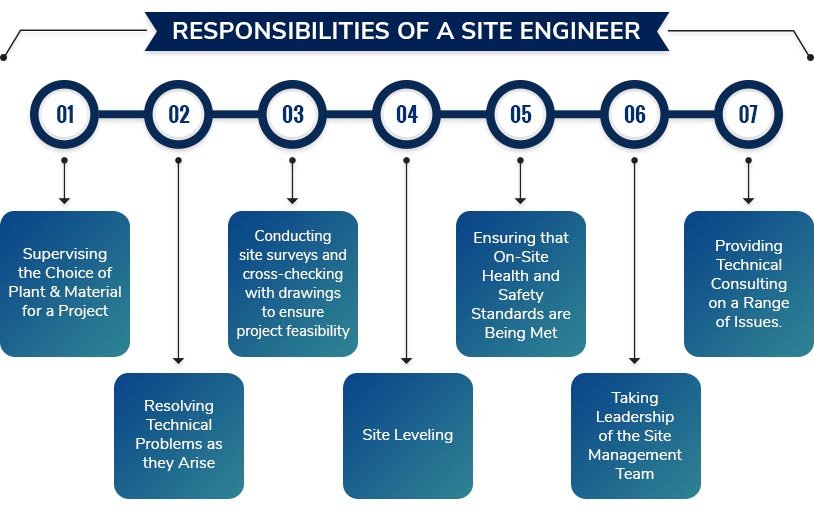
Here’s a detailed look at what a civil site engineer actually does day-to-day.
1. Pre-Construction Preparation
- Study architectural, structural, and MEP drawings carefully.
- Prepare the layout plan and determine the setting-out points.
- Plan temporary facilities like storage areas, site offices, and utilities.
- Coordinate with the project manager for labour and equipment.
- Understand safety regulations, soil conditions, and material logistics.
2. Setting Out and Leveling
- Mark the reference lines, axes, and benchmarks on-site.
- Use surveying tools like total station, theodolite, and auto-level.
- Verify alignment and elevation before excavation or concreting.
- Correct errors before execution to avoid costly rework.
3. Supervision of Construction Activities
- Monitor all construction stages: excavation, foundation, reinforcement, concreting, plastering, and finishing.
- Check formwork, reinforcement spacing, and concrete placement.
- Ensure proper curing and removal of shuttering.
- Supervise subcontractors and daily labour.
4. Quality Control and Material Testing
- Test materials like cement, sand, and aggregate as per IS codes.
- Check slump test for workability and cube tests for concrete strength.
- Ensure reinforcement is as per design drawings and bar bending schedule (BBS).
- Maintain detailed inspection records for audit and client approval.
5. Safety Compliance and Site Discipline
- Enforce safety gear usage (helmets, gloves, boots, harnesses).
- Conduct toolbox meetings to spread awareness.
- Prevent unsafe acts, electrical hazards, and structural collapses.
- Maintain accident logs and safety audits as per Indian standards.
6. Coordination and Communication
- Coordinate between clients, consultants, and contractors.
- Attend daily progress meetings and report to project managers.
- Resolve drawing conflicts and raise RFIs (Request for Information).
- Communicate clearly with workers about daily targets.
7. Documentation and Record Keeping
- Maintain daily progress reports and material registers.
- Prepare site measurement books for billing.
- Track labour attendance and productivity.
- Keep as-built drawings, photos, and checklists updated.
8. Cost and Time Management
- Plan daily and weekly work schedules.
- Track progress vs. baseline schedule.
- Monitor material usage to control wastage.
- Prepare cost variation reports for billing adjustments.
🕐 Typical Day of a Civil Site Engineer
| Time | Activity |
|---|---|
| 7:00 AM | Site inspection and safety briefing |
| 8:00 AM | Setting out, checking shuttering and rebar |
| 10:00 AM | Coordination with material suppliers |
| 12:00 PM | Monitor concreting or masonry works |
| 2:00 PM | Quality checks, curing supervision |
| 4:00 PM | Documentation and report preparation |
| 5:00 PM | Meeting with project manager and planning for next day |
📐 Skills Required for a Civil Site Engineer
A successful site engineer needs both technical and management skills.
| Skill Type | Description |
|---|---|
| Technical | Knowledge of materials, IS codes, and construction processes |
| Analytical | Ability to solve problems quickly and make site-level decisions |
| Communication | Coordination between workers, contractors, and clients |
| IT Skills | Basic knowledge of AutoCAD, MS Excel, and project scheduling software |
| Quality Assurance | Familiarity with testing methods and documentation |
| Safety Awareness | Understanding of safety procedures and risk management |
In India, engineers with software skills (like AutoCAD, Revit, or MS Project) and strong documentation ability are in high demand.
⚙️ Tools and Equipment Used by Site Engineers
| Category | Tools/Equipment |
|---|---|
| Surveying Tools | Total Station, Theodolite, Auto Level, Measuring Tape |
| Quality Testing | Slump Cone, Cube Moulds, Compression Testing Machine |
| Measurement | Vernier Caliper, Steel Scale, Laser Distance Meter |
| Digital Tools | AutoCAD, Excel, MS Project, Mobile Reporting Apps |
| Safety Gear | Helmet, Gloves, Reflective Jacket, Safety Shoes, Harness |
Mastery of these tools ensures accuracy, safety, and productivity on construction sites.
📏 Quality Control Checklist
| Activity | Quality Check | IS Code Reference |
|---|---|---|
| Concrete Mix | Slump test, Cube test | IS 456:2000 |
| Reinforcement | Cover, spacing, lap length | IS 2502 |
| Masonry | Mortar ratio, alignment | IS 2212 |
| Plaster | Thickness, surface finish | IS 1661 |
| Curing | Duration, method | IS 456 |
Adhering to IS codes ensures long-lasting and defect-free construction.
🧩 Common Site Challenges and Solutions
Problem: Delay in material supply
Solution: Maintain buffer stock and follow procurement schedules.
Problem: Honeycombing in concrete
Solution: Ensure proper vibration and mix consistency.
Problem: Poor alignment in brickwork
Solution: Use plumb line, level, and check course alignment regularly.
Problem: Labour shortage during peak season
Solution: Engage local labour contractors in advance and plan shifts.
By identifying these problems early, a site engineer prevents cost overruns and maintains project timelines.
💼 Career Growth Path of a Civil Site Engineer
| Experience | Designation | Key Responsibilities |
|---|---|---|
| 0–2 years | Junior Site Engineer | Supervision, documentation, quality checks |
| 3–5 years | Site Engineer / QA Engineer | Independent supervision, client interaction |
| 6–10 years | Project Engineer / Senior Engineer | Planning, team management, progress reporting |
| 10+ years | Project Manager / Construction Manager | Full project responsibility, cost & time control |
The career path offers steady growth, especially for engineers who learn project management, BIM, and contract management.
🧾 Documentation Responsibilities
A site engineer must maintain:
- Site diary and progress log.
- Material inspection and testing records.
- Labour attendance sheets.
- Client and consultant approval registers.
- Billing measurement sheets.
- As-built and handover documents.
Accurate documentation builds credibility and helps during audits or claims.
🧱 Best Practices for Indian Site Engineers
- Follow IS codes and IRC guidelines during construction.
- Verify all levels before concreting or pouring.
- Keep safety a top priority.
- Maintain strong coordination with electrical and plumbing teams.
- Use digital tools for faster reporting and photo documentation.
- Always carry drawings and note deviations immediately.
Small good habits make a big difference in site efficiency.
📚 FAQs
Q1: What is the main duty of a civil site engineer?
A civil site engineer ensures that construction work is executed as per design, quality, and safety standards.
Q2: What qualifications are needed to become a site engineer in India?
A BE/B.Tech or Diploma in Civil Engineering from a recognized institution. Practical site experience is highly valued.
Q3: What software should a site engineer learn?
AutoCAD, MS Excel, MS Project, and sometimes Revit or STAAD Pro for design understanding.
Q4: What is the average salary of a site engineer in India?
As of 2025, entry-level site engineers earn ₹2.5–₹4.5 lakhs per annum, while experienced engineers can earn ₹6–₹12 lakhs depending on project type and company.
Q5: Is safety training mandatory for site engineers?
Yes. Safety awareness and compliance with labour laws are mandatory under Indian construction norms.
Conclusion
The civil site engineer is the foundation of every successful project.
They ensure that every beam, column, and slab is built as per design and standards.
Their responsibilities span across planning, supervision, testing, documentation, and coordination.
In India, where construction is rapidly expanding, the demand for skilled and responsible site engineers is immense.
For students and young professionals, mastering technical skills, safety awareness, and digital tools can open a rewarding career path.
A site engineer’s dedication ensures that India’s infrastructure is strong, safe, and sustainable.