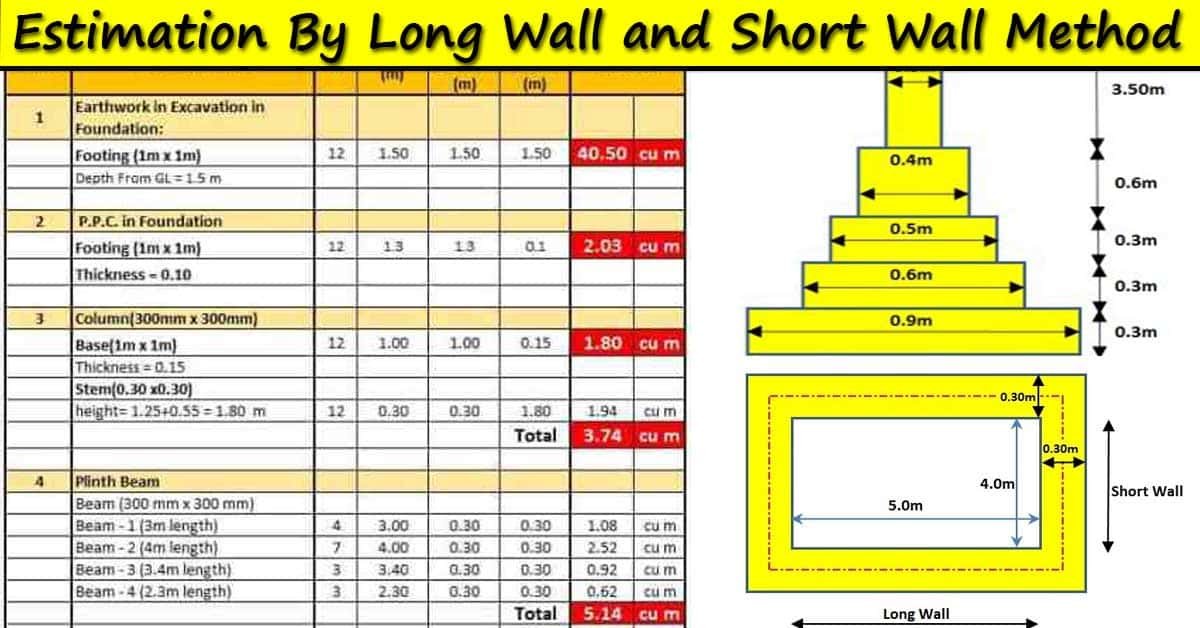
Estimating brickwork is one of the most important parts of building construction. Every site engineer, civil engineering student, and quantity surveyor should understand how to calculate masonry quantities accurately.
Among several estimation techniques, the Long Wall and Short Wall Method is the most widely used and practical one, especially in India.
In this detailed guide, we’ll explore the definition, procedure, formulas, examples, advantages, limitations, and FAQs related to the Long Wall and Short Wall Method. The article is written in simple English and formatted for high readability with short sentences, bullet points, and tables.
It is also SEO optimized with relevant keywords like:
Long wall and short wall method, brickwork estimation, civil engineering estimation methods, building estimation techniques, brick quantity calculation, wall estimation formula, and BOQ preparation in India.
What is the Long Wall and Short Wall Method?
The Long Wall and Short Wall Method (LWSW) is a traditional method used to estimate the quantity of brickwork or masonry in a building.
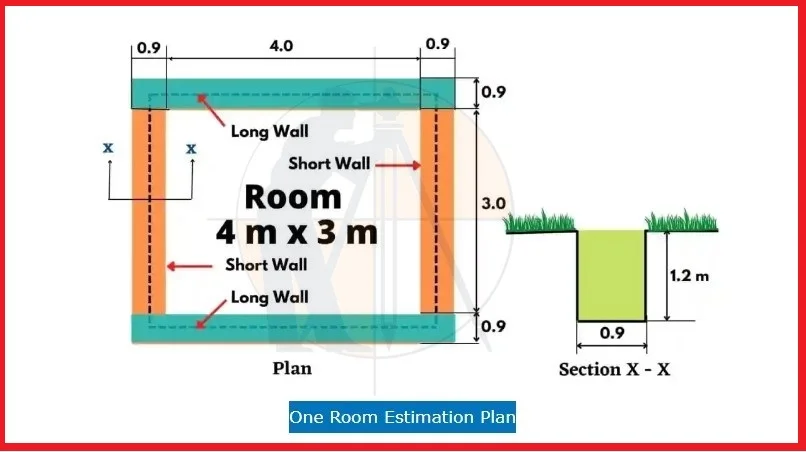
In this method, the walls of a room or structure are divided into two types:
- Long Walls – The walls that run along the length of the room.
- Short Walls – The walls that run along the width of the room.
Each wall is measured separately, and the total brickwork quantity is calculated by multiplying length × height × thickness for each wall.
After calculating gross quantities, deductions are made for openings such as doors, windows, and ventilators.
Importance of Long Wall and Short Wall Method in Construction
This method is especially useful in residential and small commercial buildings with rectangular rooms.
It helps engineers:
- Estimate the volume of brickwork accurately.
- Calculate required materials like bricks, cement, sand, and mortar.
- Prepare BOQ (Bill of Quantities) for tendering.
- Control cost and materials wastage on-site.
- Compare actual vs estimated quantities during construction.
When to Use the Long Wall and Short Wall Method
You can use this method when:
- The building has rectangular or square rooms.
- Wall thickness is uniform throughout the structure.
- Openings like doors and windows are regular in size and shape.
- You want a quick and simple estimation without complex geometry.
However, for irregular or circular structures, the Centre Line Method is more suitable.
Formula Used in Long Wall and Short Wall Method
The general formula for estimating wall quantity: Quantity of Brickwork=Length×Thickness×Height\text{Quantity of Brickwork} = \text{Length} × \text{Thickness} × \text{Height}Quantity of Brickwork=Length×Thickness×Height
For each wall:
| Type of Wall | Formula for Length Calculation |
|---|---|
| Long Wall | Centre-to-Centre Length + Half Thickness on both ends |
| Short Wall | Centre-to-Centre Length − Half Thickness on both ends |
Step-by-Step Procedure for Long Wall and Short Wall Estimation
Follow this systematic approach for accurate results:
Step 1: Collect Basic Data
Record the following details from the drawing or site:
- Length and width of the room.
- Wall thickness (commonly 230 mm, 115 mm, or 75 mm).
- Height of the wall (floor to ceiling).
- Size and number of openings (doors, windows, etc.).
Step 2: Identify Long and Short Walls
- The walls parallel to the longer side of the room are long walls.
- The walls parallel to the shorter side are short walls.
For a rectangular room, there will be two long walls and two short walls.
Step 3: Calculate the Centre-to-Centre Length of Each Wall
Centre-to-centre length = Room length or width + Wall thickness (for outer walls).
This helps in adjusting overlaps at corners correctly.
Step 4: Determine the Lengths of Long and Short Walls
| Wall Type | Outer to Outer Length | Inner to Inner Length |
|---|---|---|
| Long Wall | Centre length + Half wall thickness on both sides | Centre length − Half wall thickness on both sides |
| Short Wall | Centre length − Half wall thickness on both sides | Centre length + Half wall thickness on both sides |
Step 5: Calculate Volume of Brickwork
Volume = Length × Thickness × Height
Do this separately for long walls and short walls.
Add all wall volumes to get the gross brickwork volume.
Step 6: Deduct Openings
Deduct the volume of doors, windows, ventilators, and niches. Net Brickwork Volume=Gross Volume−Openings Volume\text{Net Brickwork Volume} = \text{Gross Volume} – \text{Openings Volume}Net Brickwork Volume=Gross Volume−Openings Volume
Step 7: Add Wastage
Add a 5–10% allowance for wastage depending on project conditions.
Example — Estimation Using Long Wall and Short Wall Method
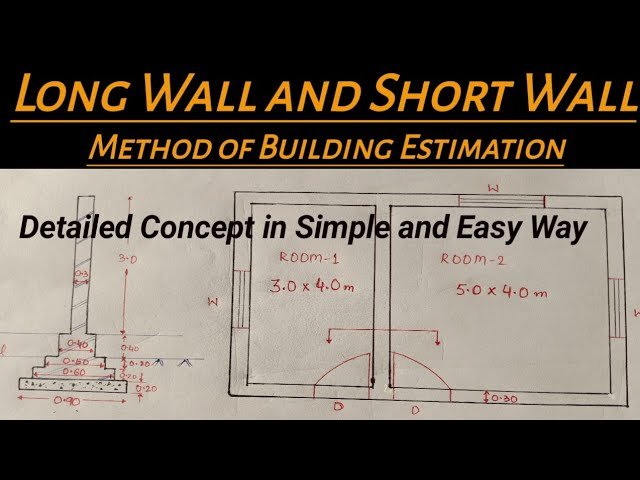
Let’s calculate for a rectangular room:
Given Data:
- Room size = 6 m × 4 m
- Wall thickness = 0.23 m
- Wall height = 3 m
- Openings: 1 door (1.0 m × 2.1 m), 2 windows (1.2 m × 1.2 m)
Step 1: Identify Long and Short Walls
| Wall Type | Centre Length | Outer Length | Inner Length |
|---|---|---|---|
| Long Wall | 6 m | 6.23 m | 5.77 m |
| Short Wall | 4 m | 3.77 m | 4.23 m |
Step 2: Calculate Gross Brickwork Volume
| Wall Type | No. of Walls | Length (m) | Thickness (m) | Height (m) | Volume (m³) |
|---|---|---|---|---|---|
| Long Wall | 2 | 6.23 | 0.23 | 3.00 | 8.58 |
| Short Wall | 2 | 3.77 | 0.23 | 3.00 | 5.19 |
| Total Gross Volume | 13.77 m³ |
Step 3: Deduct Openings
Door = 1.0 × 2.1 × 0.23 = 0.48 m³
Windows = 1.2 × 1.2 × 0.23 × 2 = 0.66 m³
Total openings = 0.48 + 0.66 = 1.14 m³
Net Brickwork Volume = 13.77 − 1.14 = 12.63 m³
Also Read Underwater Concreting by Tremie Method: A Complete Guide for Civil Engineers
Step 4: Material Calculation
Bricks required (230 mm wall):
≈ 500 bricks per m³
Total bricks = 12.63 × 500 = 6,315 bricks
Add 5% wastage → 6,315 × 1.05 = 6,630 bricks
Mortar volume (approx. 30% of masonry):
12.63 × 0.30 = 3.79 m³
Cement and sand (for 1:6 mix):
Dry mortar = 3.79 × 1.33 = 5.04 m³
Cement = (1/7) × 5.04 = 0.72 m³ ≈ 21 bags
Sand = (6/7) × 5.04 = 4.32 m³
Advantages of Long Wall and Short Wall Method
- Simple and easy to understand.
- Suitable for manual estimation without software.
- Quick for rectangular layouts.
- Accurate for simple buildings and small projects.
- Useful for preparing BOQ and rate analysis.
Disadvantages of Long Wall and Short Wall Method
- Not suitable for irregular or circular plans.
- Prone to errors at corners if not carefully measured.
- Requires separate calculations for openings.
- Not efficient for multi-storey buildings or complex geometries.
Comparison: Long Wall and Short Wall vs Centre Line Method
| Feature | Long Wall & Short Wall Method | Centre Line Method |
|---|---|---|
| Accuracy | High for rectangular rooms | High for irregular layouts |
| Simplicity | Easier for small projects | Complex for beginners |
| Best suited for | Simple buildings | Complex or circular buildings |
| Time required | Moderate | Less (for experienced estimators) |
Common Mistakes and How to Avoid Them
- Not adjusting wall thickness at corners.
- Ignoring deductions for door and window openings.
- Using wrong brick size for estimation.
- Skipping wastage allowance.
- Rounding off dimensions too early.
Tips for Indian Site Engineers
- Use 230 mm thick walls for main walls and 115 mm for partition walls.
- Confirm brick size before estimating (modular vs traditional).
- Follow CPWD/State PWD DSR for rates and material conversion factors.
- Always mention mix ratio (1:4, 1:6) and plaster inclusion/exclusion.
- Verify calculations using a BOQ template or Excel estimation sheet.
Sample Table — Brick and Mortar Requirement
| Wall Type | Area (m²) | Bricks (Nos) | Mortar (m³) | Cement Bags | Sand (m³) |
|---|---|---|---|---|---|
| Long Wall | 37.38 | 3,330 | 1.20 | 7 | 1.44 |
| Short Wall | 17.85 | 1,590 | 0.60 | 3.5 | 0.72 |
| Total | 55.23 | 4,920 | 1.80 | 10.5 | 2.16 |
Frequently Asked Questions (FAQs)
1. What is the Long Wall and Short Wall Method used for?
It is used for estimating the total quantity of brickwork and related materials in buildings with rectangular plans.
2. What is the difference between long wall and short wall?
The long wall runs parallel to the longer side of the room, while the short wall runs along the shorter side.
3. Is this method accurate?
Yes, it is accurate for simple, rectangular structures if wall thickness and openings are properly adjusted.
4. How much wastage should I consider?
Typically 3–5% for bricks, depending on handling and site conditions.
5. Can I use this method for multi-storey buildings?
Yes, but it is recommended for the ground floor or simple wall layouts. Complex structures should use the Centre Line Method.
Conclusion
The Long Wall and Short Wall Method remains one of the simplest and most effective techniques for brickwork estimation in India.
It helps civil engineers, estimators, and site supervisors quickly determine the quantity of bricks, mortar, cement, and sand required for construction.
By mastering this method, you can create accurate BOQs, reduce material wastage, and improve cost efficiency.
If you are preparing for a civil engineering interview, government exam, or site work, this method is a must-know.
It combines accuracy, simplicity, and practical application — the foundation of every well-estimated construction project.