Understanding the difference between architectural drawings and structural drawings is essential for every civil engineer, architect, and contractor in India.
Both are critical documents in the building construction process, yet they serve completely different purposes.
One focuses on appearance and layout, while the other focuses on strength and stability.
Let’s explore both in detail — their definitions, components, differences, importance, and how they work together to make buildings safe and beautiful.
🔹 What Are Architectural Drawings?
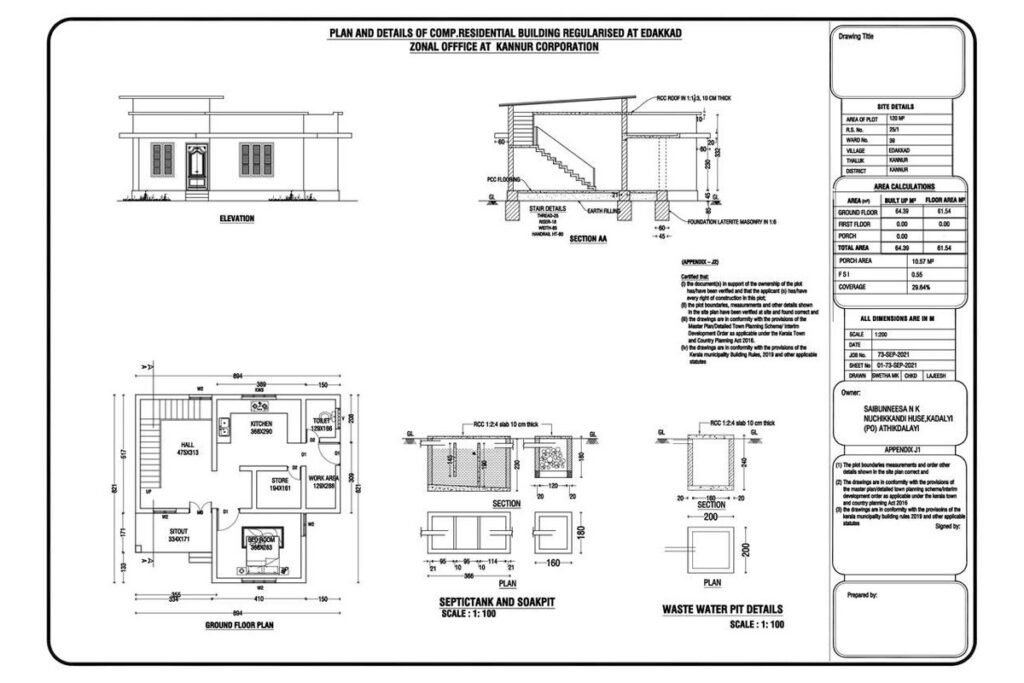
Architectural drawings are visual representations of a building’s design and layout.
They show how spaces will look and function after construction.
These drawings are made by architects and form the foundation of every project.
They focus on aesthetics, user comfort, ventilation, lighting, and space utilization — not structural strength.
Architectural drawings help clients visualize the design before construction begins.
📄 Common Types of Architectural Drawings
| Type of Drawing | Description |
|---|---|
| Site Plan | Shows building location, boundaries, access roads, and landscape. |
| Floor Plan | Horizontal view showing rooms, walls, doors, and windows. |
| Elevation | Exterior view showing building height, materials, and finishes. |
| Section | Cut-through view showing heights, stairs, and structural layout. |
| Roof Plan | Shows slope, parapet walls, drainage, and solar panels. |
| Detail Drawings | Close-up views of important features like doors, windows, or stairs. |
| Schedules | Lists sizes, materials, and quantities (doors, windows, finishes). |
✅ Key Features of Architectural Drawings
- Focus on appearance and functionality
- Include dimensions, finishes, materials, and levels
- Use clear symbols and line types
- Help in approvals and client presentations
- Used by architects, clients, interior designers, and builders
Architectural drawings define how the building will look and how people will experience it.
🔹 What Are Structural Drawings?
Structural drawings are technical drawings prepared by structural engineers.
They show how the building will stand and bear loads safely.
These drawings guide contractors in constructing foundations, beams, columns, slabs, and reinforcement.
They translate the architect’s vision into a safe and buildable structure.
📄 Common Types of Structural Drawings
| Type of Drawing | Description |
|---|---|
| Foundation Plan | Shows footing sizes, layout, and reinforcement details. |
| Column Layout | Displays column positions and sizes on each floor. |
| Beam Layout | Shows beam sizes, locations, and reinforcement bars. |
| Slab Details | Indicates thickness, reinforcement spacing, and openings. |
| Staircase Details | Reinforcement and rise/run information for stairs. |
| Bar Bending Schedule (BBS) | Table listing bar lengths, bends, diameters, and quantities. |
| General Notes | Mention design codes, materials, and construction specifications. |
✅ Key Features of Structural Drawings
- Show dimensions, reinforcement, and load details
- Ensure structural stability and safety
- Must follow IS codes and NBC (National Building Code of India)
- Used by engineers, site supervisors, and contractors
- Specify material strengths like M25 concrete, Fe500 steel, etc.
🔹 Main Difference Between Architectural and Structural Drawings
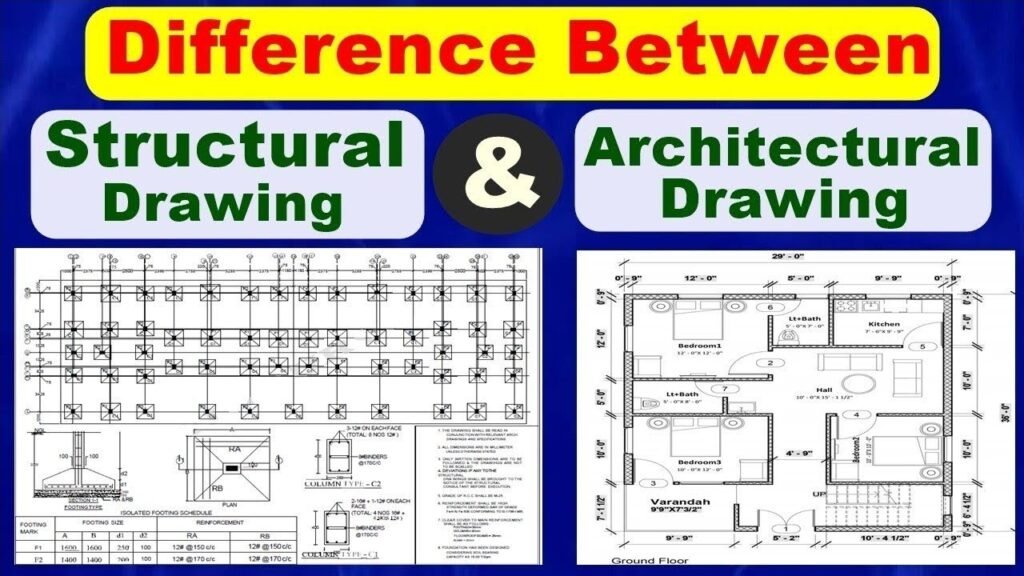
Here’s a simple comparison that highlights the clear difference between the two:
| Aspect | Architectural Drawings | Structural Drawings |
|---|---|---|
| Prepared by | Architect | Structural Engineer |
| Purpose | Show layout, space, and aesthetics | Show load-bearing and safety systems |
| Focus | Appearance, lighting, comfort | Strength, load distribution, reinforcement |
| Main Elements | Rooms, doors, windows, finishes | Beams, columns, slabs, foundations |
| Scale | 1:50, 1:100 | 1:50, 1:25, 1:10 (for details) |
| Codes Used | NBC, IS 962 (Drawing Practice) | IS 456, IS 1893, IS 1904, NBC |
| Used by | Architects, clients, interior designers | Engineers, contractors, site staff |
| Level of Detail | Medium (dimensions, finishes) | High (sizes, reinforcement, load) |
| Purpose in Construction | Visual guidance | Structural integrity |
In simple words:
- Architectural drawings make the building look right.
- Structural drawings make the building stand right.
Also Read RCC Column Design Guide: Steps, Code Requirements, and Best Practices for Indian Construction
🔹 How the Two Work Together (Step-by-Step Workflow)
A smooth building project depends on how well architects and engineers collaborate.
Here’s how the process typically flows in India:
- Concept Design – Architect creates basic plans and elevations.
- Structural Input – Structural engineer studies loads and building type.
- Design Development – Both refine layouts to avoid clashes (e.g., column in front of window).
- Approval Stage – Final coordinated drawings submitted to municipal authorities.
- Working Drawings – Detailed construction drawings issued to site.
- Shop Drawings & BBS – Contractors prepare reinforcement schedules for execution.
When architectural and structural drawings align, construction goes smoothly.
When they don’t, delays and cost overruns follow.
🔹 Important Indian Codes and Standards
All design and construction in India must follow Bureau of Indian Standards (BIS) codes and the National Building Code (NBC).
| Code | Subject |
|---|---|
| IS 456:2000 | Code of Practice for Plain and Reinforced Concrete |
| IS 1893:2016 | Earthquake Resistant Design of Structures |
| IS 1904:2020 | Design and Construction of Foundations |
| IS 962:1989 | Code for Architectural Drawing Practice |
| NBC 2016 | National Building Code of India (general guidelines) |
Structural drawings must clearly mention these codes in the general notes section.
Architectural drawings must comply with NBC building bye-laws for setback, height, and fire safety.
🔹 Common Mistakes and Coordination Problems
In many Indian projects, poor coordination between architectural and structural drawings leads to on-site confusion.
Common issues include:
- Column placed in the middle of a door or window
- Beam depth interfering with false ceiling or ducts
- Foundation clash with plumbing lines
- Staircase headroom problems
- Slab drops blocking electrical conduits
✅ Solutions
- Conduct regular coordination meetings between architect, structural, and MEP teams
- Overlay both drawings on one sheet to check for clashes
- Freeze column grid before finalizing architectural plan
- Update both sets whenever changes occur
- Use BIM (Building Information Modeling) to visualize conflicts before construction
🔹 Scales Used in Architectural & Structural Drawings
| Drawing Type | Common Scale |
|---|---|
| Site Plan | 1:200 / 1:500 |
| Floor Plan | 1:50 / 1:100 |
| Elevation / Section | 1:50 |
| Detail Drawings | 1:10 / 1:5 |
| Structural Detail (Rebar) | 1:10 / 1:20 |
Following proper scales ensures that drawings remain clear and readable for site engineers.
🔹 Reading Construction Drawings on Site
Many site engineers struggle to interpret drawings properly.
Here’s a quick guide:
- Start with Title Block – Check project name, drawing number, revision date, and scale.
- Read General Notes – These contain crucial instructions like concrete grade, cover, and codes.
- Understand Grid Lines – Use grids to locate columns and walls on site.
- Follow Dimensions Exactly – Never scale drawings by eye.
- Cross-check Revisions – Always ensure the latest revision is used.
- Clarify Conflicts Early – Never guess — consult architect or engineer before proceeding.
Proper reading of drawings reduces mistakes and rework.
🔹 Cost Estimation and Quantity Take-Offs
Both drawing sets play a big role in cost estimation:
- Architectural drawings help estimate finishes, paint, doors, windows, and flooring.
- Structural drawings help calculate concrete volume, steel quantity, and formwork area.
Estimators use these to prepare BOQs (Bill of Quantities) and project budgets.
Accurate drawings save money and prevent disputes later.
🔹 Modern Tools Used in India
Today’s design professionals use advanced software for accuracy and coordination:
| Software | Purpose |
|---|---|
| AutoCAD | 2D drafting of architectural and structural drawings |
| Revit | BIM software for 3D modeling and clash detection |
| STAAD Pro / ETABS | Structural analysis and design |
| SketchUp / Lumion | Visualization and rendering |
| Navisworks | Coordination and simulation of multiple drawings |
Even small offices in India are shifting from traditional 2D CAD to BIM-based workflows for better integration and visualization.
🔹 Legal and Approval Requirements in India
Before starting construction, both architectural and structural drawings must be approved by local authorities.
- Municipal Corporation or Development Authority checks:
- Plot boundaries and setbacks (from architectural drawings)
- Structural safety (from structural drawings)
- Fire safety and accessibility
- Structural drawings must be signed by a licensed structural engineer.
- For high-rise or complex projects, a peer review may be required.
Failure to get proper approval can result in penalties or stoppage of work.
🔹 On-Site Best Practices Checklist
Before construction begins, make sure these are ready:
✅ Finalized architectural and structural drawings (signed and stamped)
✅ Structural general notes mentioning IS codes and material grades
✅ Soil report and foundation design
✅ Bar Bending Schedule (BBS) for reinforcement
✅ Shop drawings for steel and formwork
✅ Coordination meeting between all disciplines
✅ Digital backup and revision tracking system
A coordinated approach ensures that what is designed on paper is built exactly on site.
🔹 Example: Solving a Real Coordination Issue
Situation:
The architect places a large 2 m × 2 m window in the north wall.
The structural drawing shows a column at the same position.
Solution Steps:
- Arrange a coordination meeting between architect and structural engineer.
- Check if the column can be shifted or reduced.
- If not, modify window size or move it slightly.
- Update both drawings and issue revised versions.
- Inform the site team to use the latest drawings only.
This example shows how teamwork and early coordination save time and cost.
🔹 SEO Keywords You Can Integrate (for Web Publishing)
(Use naturally throughout blog or article headings)
architectural drawings, structural drawings, difference between architectural and structural drawings, construction drawings, building plan India, civil engineering drawings, IS codes for civil engineering, National Building Code, reinforcement details, bar bending schedule, structural design India, architectural plan, foundation drawings, column layout plan, beam and slab details, civil site engineer tips.
🔹 FAQs (Frequently Asked Questions)
1. Which is more important: architectural or structural drawings?
Both are equally important. Architectural drawings show how the building looks. Structural drawings ensure it stands safely. You need both for a complete project.
2. Can a contractor change structural details on site?
No. Any change must be approved by the structural engineer. Unapproved changes can cause serious safety risks.
3. What is a Bar Bending Schedule (BBS)?
It is a tabular format listing all reinforcement bar sizes, bends, shapes, and lengths used in the project. It is based on structural drawings.
4. Which Indian standards control these drawings?
Architectural drawings follow IS 962 and NBC 2016. Structural drawings follow IS 456, IS 1893, IS 1904, and other relevant IS codes.
5. What software do Indian architects and engineers commonly use?
AutoCAD for drafting, Revit for BIM, ETABS or STAAD Pro for structural design, and SketchUp for 3D visualization.
6. How can clashes between architecture and structure be avoided?
Through early coordination meetings, overlaying drawings, and using BIM for visual conflict detection.
7. Do I need both drawings for municipal approval?
Yes. Most authorities require both architect’s and structural engineer’s signed drawings before granting approval.
🔹 Glossary (Simple Definitions)
- BBS – Bar Bending Schedule
- NBC – National Building Code of India
- BIM – Building Information Modeling
- Elevation – Exterior face view of a building
- Section – Vertical cut-through view of structure
- Gridlines – Reference lines used to locate elements on plan
- Footing – Lowest part of foundation transferring loads to soil
🏁 Conclusion
Architectural and structural drawings are two pillars of any construction project.
While architectural drawings focus on design, comfort, and appearance, structural drawings ensure strength, durability, and safety.
For successful construction in India, both must be accurate, updated, and well-coordinated.
Always follow Indian Standards (IS codes) and the National Building Code (NBC).
Maintain close communication between architects, engineers, and contractors.
Use modern tools like AutoCAD, Revit, and BIM to minimize errors.
When both design and structure work in harmony, the result is a safe, functional, and aesthetically pleasing building that stands the test of time.