Pouring concrete under water is one of the most challenging construction tasks. It requires precision, planning, and the right method to ensure strength and durability. Among all available techniques, the Tremie Method stands out as the most effective and widely used process for underwater concreting. It prevents segregation, reduces cement washout, and ensures high-quality placement of concrete in deep or submerged areas.
This detailed article explains everything about Underwater Concreting using the Tremie Method — from equipment, working principle, mix design, and step-by-step procedures to advantages, common problems, and FAQs. The content is simplified for better readability and tailored to suit Indian construction practices.
What Is the Tremie Method?
The Tremie Method is a specialized technique used to place concrete under water without disturbing the mix. It involves a vertical, watertight pipe called a tremie, which delivers concrete directly to the required depth. The lower end of the pipe remains submerged in the freshly placed concrete, preventing contact between the flowing concrete and surrounding water.
This method is widely used for:
- Bored pile foundations
- Caissons and well foundations
- Bridge piers and abutments
- Underwater retaining walls and cofferdams
- Marine and harbor structures
By using this technique, engineers can achieve strong, monolithic, and durable underwater concrete structures without the need for dewatering.
Why Is the Tremie Method Important?
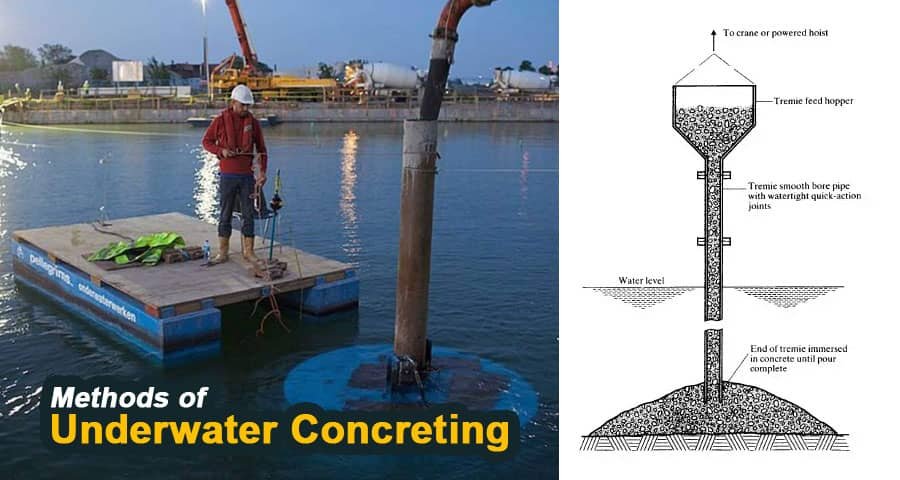
Underwater concreting poses unique challenges. If concrete is poured directly into water, the cement particles wash away, leading to segregation and poor strength. The Tremie Method solves this by:
- Ensuring a continuous, controlled flow of concrete.
- Preventing direct contact between water and concrete.
- Maintaining a uniform and dense structure.
It is the most reliable method for underwater concrete placement, especially in Indian infrastructure projects such as bridges, dams, ports, and offshore structures.
Key Components of the Tremie System
| Component | Description and Function |
|---|---|
| Tremie Pipe | A steel pipe (150–300 mm diameter) used to carry concrete under water. It is assembled in sections using flanges or couplers. |
| Hopper | A funnel-shaped container attached to the top of the tremie pipe to pour concrete. |
| Bottom Plug / Valve | A temporary seal that prevents water entry until pouring starts. It opens when concrete flow begins. |
| Support Frame or Crane | Holds the tremie pipe vertically and allows smooth lifting or lowering during placement. |
| Anti-Washout Admixtures (AWA) | Chemical additives used to make the concrete mix more cohesive and resistant to water washout. |
Also Read Haunch Bars in Construction: Meaning, Purpose, Design & Detailing Explained
Concrete Mix Design for Tremie Concreting
A good underwater concrete mix is crucial for success. It must be cohesive, workable, and non-segregating.
Essential Mix Parameters
| Property | Typical Requirement |
|---|---|
| Slump (Workability) | 150–200 mm |
| Water–Cement Ratio (W/C) | 0.40–0.50 (use admixtures for workability) |
| Aggregate Size | 10–20 mm maximum |
| Cement Content | 350–450 kg/m³ |
| Admixtures | Anti-washout, superplasticizers |
| Concrete Grade | M25–M40 (as per design requirements) |
Key Points for Mix Design
- Use well-graded aggregates to minimize voids.
- Add anti-washout admixtures (AWA) to increase viscosity.
- Maintain continuous mixing and placing to avoid cold joints.
- Include fly ash or silica fume to improve cohesiveness and durability.
Step-by-Step Tremie Concreting Procedure
1. Preparation and Setup
- Ensure the excavation or formwork is clean and stable.
- Assemble the tremie pipe and check for leaks.
- Attach the hopper at the top and seal the bottom with a plug.
- Position the tremie vertically in the placement area.
2. Initial Charging
- Fill the hopper with concrete while the pipe bottom remains closed.
- Release the plug so that concrete displaces water at the base.
- Keep the lower end always submerged in fresh concrete to prevent washout.
3. Continuous Placement
- Maintain a minimum concrete head of 1–2 m inside the pipe.
- As concrete rises, gradually lift the tremie pipe without exposing the tip.
- Ensure uninterrupted flow of concrete from the hopper.
- Overlap each layer to create a continuous mass.
4. Completion
- Once the required level is reached, stop concrete flow smoothly.
- Withdraw the tremie carefully while keeping the lower end submerged.
- Do not disturb the surface until initial setting occurs.
Advantages of Tremie Method
| Advantages | Description |
|---|---|
| Prevents Segregation | Concrete flows smoothly under water without mixing with it. |
| Maintains Quality | Reduces cement loss and ensures uniform strength. |
| Economical for Deep Foundations | Ideal for piles, caissons, and large-scale underwater works. |
| No Need for Dewatering | Saves time and cost in marine or river projects. |
| Improves Durability | Ensures a dense, monolithic structure with low permeability. |
Limitations of Tremie Method
| Limitations | Explanation |
|---|---|
| Requires Skilled Supervision | Mistakes in handling can cause defects. |
| Continuous Concrete Supply Needed | Interruptions may lead to cold joints. |
| Difficult Quality Checks | Visual inspection during pour is impossible. |
| Special Mix Needed | Anti-washout admixtures increase cost slightly. |
Quality Control and Inspection
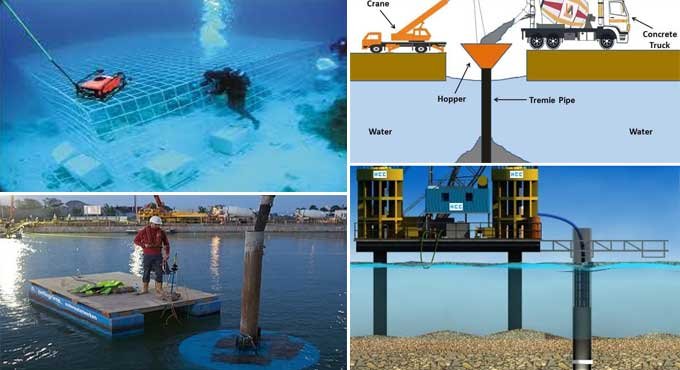
Quality assurance is vital during underwater concreting. Some important checks include:
Before Concreting
- Check pipe alignment and tightness.
- Verify mix design and admixture dosage.
- Confirm that reinforcement is properly fixed.
During Concreting
- Monitor concrete flow rate and head pressure.
- Maintain continuous flow to avoid gaps or voids.
- Record volume of concrete used versus theoretical requirement.
After Concreting
- Test concrete cubes for compressive strength.
- Inspect surface after dewatering for honeycombing or segregation.
- Conduct core tests if necessary for critical structures.
Common Problems and Their Solutions
| Problem | Cause | Solution |
|---|---|---|
| Cement Washout | Tremie end lifted above fresh concrete | Keep pipe end embedded 1–2 m in concrete |
| Segregation | Poor mix or high water content | Use cohesive mix and anti-washout admixture |
| Cold Joints | Delay in concrete supply | Plan continuous supply and backup |
| Voids and Honeycombing | Improper flow or blockage | Ensure correct pipe diameter and flow rate |
| Blockage in Pipe | Large aggregate or stiff mix | Check grading and maintain mix consistency |
Safety and Environmental Precautions
- Always wear PPE (gloves, helmet, gumboots).
- Ensure stable working platforms for tremie handling.
- Dispose of excess slurry responsibly — avoid polluting water bodies.
- Use barriers and warning signs at marine or bridge sites.
- Maintain communication between pump operator, site engineer, and diver (if present).
Practical Tips for Site Engineers
- Always trial test your tremie mix before large-scale use.
- Avoid excessive vibration underwater — it can disturb the mix.
- For large pours, use two or more tremie pipes simultaneously.
- Keep the pipe vertical and steady throughout the pour.
- Use a recording sheet for volume, head height, and concrete time intervals.
Applications of Tremie Concreting in India
The Tremie Method is extensively used in:
- Bridge foundations across rivers (like Ganga, Godavari, Yamuna).
- Harbor and jetty construction in ports such as Mumbai and Chennai.
- Dam spillway plugs and underwater retaining walls.
- Metro projects involving diaphragm walls and deep basements.
Its adaptability and reliability make it a standard choice for deep foundation works in Indian civil engineering projects.
Frequently Asked Questions (FAQs)
Q1. What is the ideal slump value for tremie concrete?
The ideal slump range is 150–200 mm for smooth flow and workability.
Q2. Can normal concrete be used for tremie method?
No, it needs a modified mix with anti-washout admixtures and higher cohesiveness.
Q3. What is the minimum embedment depth of tremie pipe?
The pipe’s lower end should remain 1–2 m embedded in fresh concrete at all times.
Q4. Is pumping suitable for tremie concreting?
Yes. Pumping provides a steady flow, but care must be taken to avoid pressure surges.
Q5. What type of structures use the tremie method most?
It’s commonly used for bridge piers, caissons, bored piles, and marine foundations.
Conclusion
The Tremie Method of Underwater Concreting is a proven and efficient technique for constructing strong and durable underwater structures.
It ensures the continuous, controlled placement of concrete without segregation or washout. When properly executed with the right mix design, supervision, and equipment, it delivers excellent long-term performance.
For Indian construction sites dealing with bridges, ports, or deep foundations, the Tremie Method remains the most trusted solution for underwater concreting. Proper planning, skilled workmanship, and adherence to quality standards can make a huge difference in achieving safe and successful outcomes.