The Standard Penetration Test (SPT) is one of the most common field tests in geotechnical engineering.
It gives a quick, low-cost measure of how resistant soil is to penetration.
Engineers use it to get N-values.
N-values help estimate soil density, strength and bearing capacity.
This article explains SPT in simple language.
It is written for students, site engineers, contractors and young professionals in India.
I keep sentences short. I use easy words.
I include tables, practical notes, corrections, limitations, and Indian standards.
I also add FAQs and an SEO-friendly structure.
Quick summary — what SPT tells you
- SPT measures the number of hammer blows to drive a split spoon sampler a fixed distance.
- The result is called the N-value (blows per 300 mm or 1 ft, depending on code).
- Higher N means denser or stiffer soil.
- Lower N means loose sand or soft clay.
- Engineers use N to estimate relative density, friction angle, and bearing capacity. Wikipedia+1
Why SPT is widely used
- It is simple.
- It is cheap compared with many lab or instrumented tests.
- It gives both a disturbed soil sample and a penetration resistance.
- It is useful in many soils and many sites.
- It is part of standard practice worldwide and in India. azmanco.com+1
Basic equipment and parts
| Item | Purpose |
|---|---|
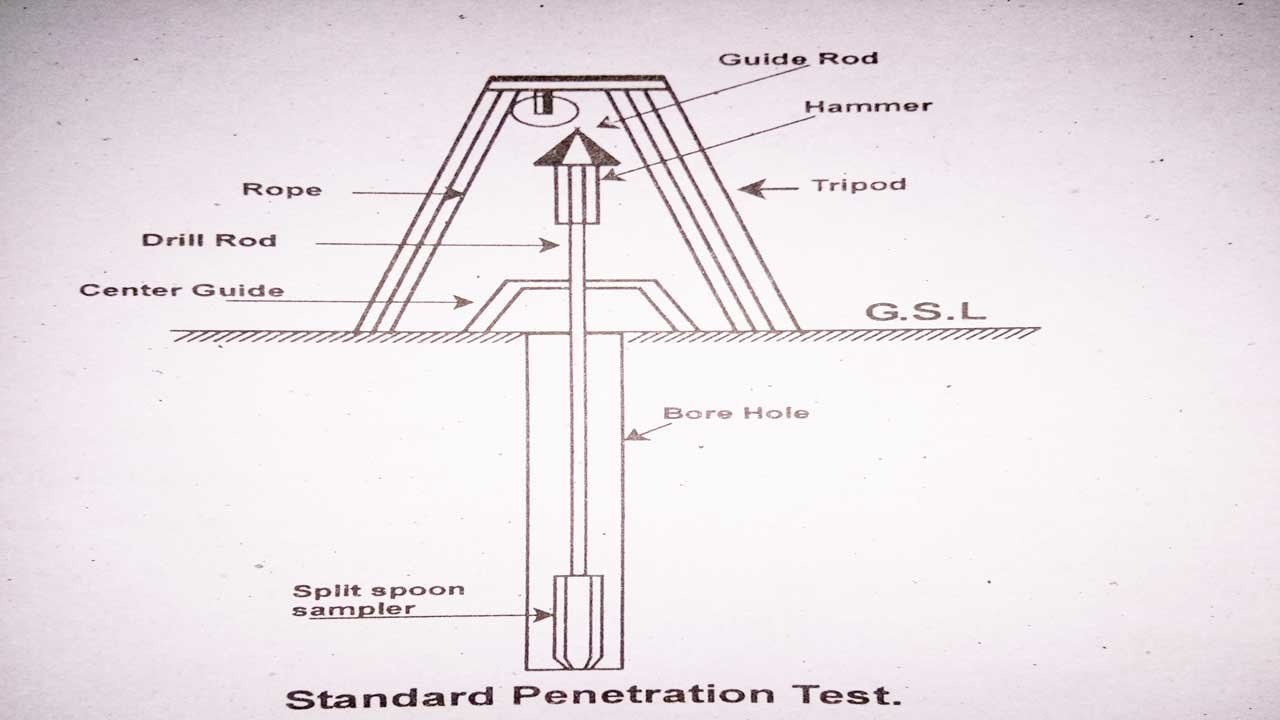
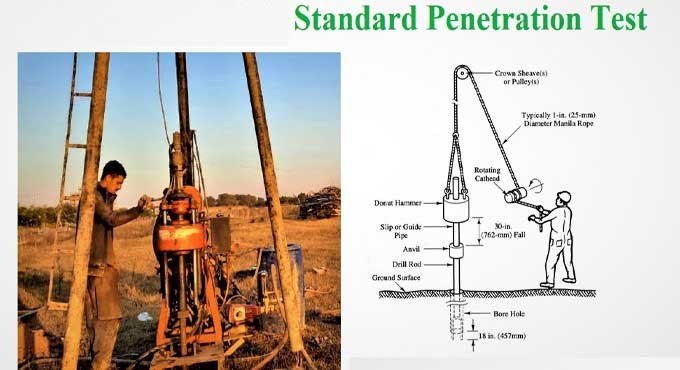
| Split spoon sampler (2 in / 50 mm OD) | Collects disturbed soil sample. |
| Drop hammer (63.5 kg falling 75 cm) | Delivers the blows. |
| Drive head / anvil | Transmits hammer blows to sampler. |
| Drill rods and rig | Position the sampler at test depth. |
| Measuring tape | Record penetration intervals. |
The classic SPT setup uses a 63.5 kg hammer dropping 75 cm.
This is the nominal configuration defined in ASTM and many national codes. azmanco.com+1
Step-by-step SPT procedure (typical)
- Drill a borehole to the planned test depth.
- Clean the borehole base and level it.
- Lower the split spoon sampler to the base.
- Lift the hammer and drop it to drive the sampler.
- Record blows for each 150 mm (6 in) interval up to 450 mm (18 in).
- If the sampler does not penetrate, stop per stopping rules.
- The N-value is the sum of blows for the second and third 150 mm intervals (i.e., blows for 150–300 mm + blows for 300–450 mm). Wikipedia+1
Stopping rules include:
- No observed advance in 10 consecutive blows.
- 50 blows for any 150 mm interval or 100 blows for the total 450 mm penetration. Wikipedia
Units, intervals and what N means
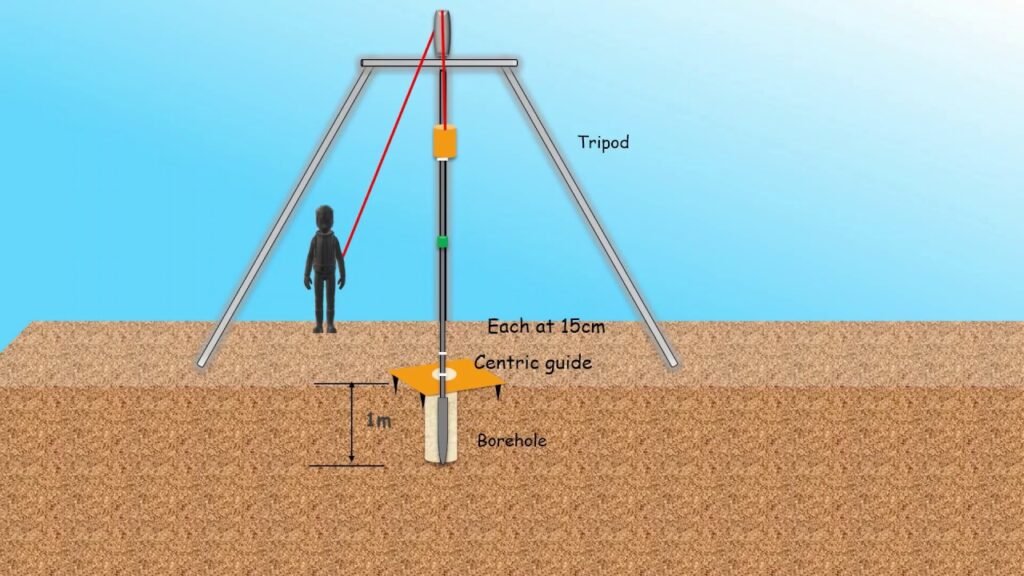
- In Indian practice, N is blows per 300 mm (or 1 ft depending on document).
- Many references use blows per 0.3 m (30 cm) or per 0.45 m total drive with the second+third 15 cm increments.
- Practically, the N-value is an index of resistance.
- It is not a direct physical property like modulus.
- It needs correlations to estimate properties like friction angle or bearing capacity.
Indian standards and codes
- IS 2131 (Method for Standard Penetration Test for soils) is the Indian code for SPT.
- IS 2131 gives equipment details, procedure and recommended corrections.
International and widely used references include:
- ASTM D1586 — Standard Test Method for SPT and Split-Barrel Sampling.
- ISO 22476-3 — Field procedures for dynamic penetration tests.
When working on Indian projects, always follow IS 2131 along with other project or client specifications.
Also Read Architectural Drawings vs Structural Drawings: Complete Guide for Civil Engineers in India
How engineers use N-values — common correlations
SPT N-values are empirical.
Engineers use correlations to estimate:
- Relative density (Dr) of sands.
- Friction angle (ϕ) for cohesionless soils.
- Undrained shear strength (cu) for clays (with caution).
- Allowable bearing capacity for shallow foundations.
- Liquefaction potential for seismic design (with corrections).
Below is a simple reference table often used in practice (approximate):
| SPT N (blows/0.3 m) | Relative density (sand) | Typical interpretation |
|---|---|---|
| 0–4 | Very loose | Very low strength |
| 4–10 | Loose | Low strength |
| 10–30 | Medium | Moderate strength |
| 30–50 | Dense | High strength |
| >50 | Very dense | Very high strength |
These ranges are approximate and depend on soil type and local calibration. Use them with professional judgement.
Corrections applied to measured N
Raw N is not always the final value used in design.
Several corrections are common:
- Energy correction (CE) — corrects for hammer energy efficiency.
- Overburden / effective stress correction (CN) — normalizes N for confining stress.
- Rod length correction (CR) — accounts for rod-length energy losses.
- Sampler and procedure corrections — for non-standard hammers or samplers.
The normalized value often used is N160 or N60, where the subscript refers to percent energy or equivalent calibration. For example, N160 means N corrected to 160% of the standard hammer energy (varies by practice). The important idea is to make N values comparable across rigs and sites.
Energy efficiency — a key issue
Different rigs and hammers do not deliver the same energy.
The 63.5 kg hammer dropping 75 cm is nominal.
But friction, hammer type, rope system, operator and rods affect delivered energy.
Studies show energy correction can change N value significantly.
Modern practice recommends measuring hammer energy at site and normalizing N.
Overburden correction (stress normalization)
N depends on in-situ vertical effective stress.
Deeper soils under high stress can show higher N even if soil fabric is similar.
So engineers often normalize N to a reference stress level.
IS codes and research papers give formulas or charts for CN.
This step helps when correlating to relative density or liquefaction charts. Internet Archive+1
Advantages of SPT
- Low cost and simple procedure.
- Collects a disturbed sample for basic identification and moisture testing.
- Long history of use and many empirical correlations.
- Useful across many types of soils. geoengineer.org+1
Limitations and criticisms
SPT has known limitations. Engineers must be aware of them.
- Disturbed samples. The split spoon often disturbs soil, so lab tests for strength can be unreliable.
- Scatter in N. N is noisy. Different operators can give different results.
- Sensitivity to rig energy. If hammer energy varies, raw N is not comparable.
- Poor performance in very soft or very dense soils. In soft soils, sampler driving disturbs the soil. In dense gravely layers, sampler may not advance.
- Empirical correlations only. N is not a direct physical property. Correlations have scatter.
- Not ideal for certain analyses. For accurate stiffness or consolidation properties, other tests (CPT, vane shear) are better. Wikipedia+1
Many modern geotechnical reports use SPT together with other tests like CPT (Cone Penetration Test), pressuremeter or shear wave testing to get a fuller picture.
SPT vs other in-situ tests
| Test | Gives | Good for |
|---|---|---|
| SPT | N-value and disturbed sample | Bearing capacity, relative density, liquefaction screening |
| CPT (Cone) | Continuous profile of tip resistance & sleeve friction | Stratigraphy, continuous stiffness, better resolution |
| Vane shear | Undrained shear strength (cu) in clays | Soft clay strength |
| Pressuremeter | In situ stress-strain response | Foundation settlements, limit pressure |
| PS logging / geophysical | Stiffness and dynamic properties | Ground improvement and seismic response |
SPT is complementary. It is inexpensive and gives a sample. CPT gives continuous and repeatable data but needs dedicated rigs and higher cost.
Typical SPT report contents
A standard SPT log or geotechnical report includes:
- Borehole location and coordinates.
- Ground surface level and date.
- Drilling method and rig type.
- Depth intervals and soil descriptions (visual classification).
- Water table depth (if encountered).
- SPT N-values at each test depth (with raw and corrected N).
- Notes on hammer type, energy efficiency and any anomalies.
- Boring log with strata thicknesses and sample depths.
- Recommendations and correlations used. Internet Archive+1
Clear documentation of hammer type, rod length and site conditions is essential when publishing N-values.
Practical tips for conducting SPT on Indian sites
- Calibrate hammer energy where possible. Measure energy efficiency or use accepted correction factors.
- Record everything. Note hammer type, drop height, rod length, and soil conditions.
- Take samples for classification. Even disturbed samples help identify soil type.
- Be careful below groundwater. Sampler driving may loosen fine sands leading to low N readings. Consider alternative tests if needed.
- Stop impulsive driving. If refusal occurs, record refusal and collect relevant notes.
- Use corrections consistently. State which corrections are applied in reports.
- Combine with other tests. For critical or seismic projects, use CPT, lab tests, or shear wave tests to supplement SPT. Maryland.gov Enterprise Agency Template+1
SPT in seismic and liquefaction evaluation
SPT N-values are widely used in liquefaction assessment.
Researchers have developed empirical charts to estimate liquefaction resistance using normalized N (corrected for energy and stress).
However, SPT-based liquefaction assessment needs careful correction and site calibration.
IS codes and international guides provide recommended procedures for seismic evaluation. Wikipedia+1
Example: How to compute a corrected N (simplified)
- Measure raw N as blows for second and third 150 mm intervals.
- Apply rod length correction (CR) if rod length differs from standard.
- Apply energy correction (CE) to normalize to a reference energy (e.g., 60% or 100% depending on practice).
- Apply overburden correction (CN) to normalize for effective stress.
Final corrected N might be written as N60 or N160 depending on the reference energy used. Always state which normalization you used in the report. Maryland.gov Enterprise Agency Template+1
Case study — short practical example (India)
Site: New residential building in coastal city.
Problem: Layer of loose sand at 3–8 m depth. Water table at 1.8 m.
SPT results: N = 4–6 between 3 and 8 m (raw).
Action: Engineer normalizes N for overburden and energy. Liquefaction charts show susceptibility. Ground improvement (vibro-compaction) recommended below foundations. Design uses improved bearing capacity after treatment.
This simple workflow (SPT → correction → correlation → decision) is common for foundation design and earthquake resilience in India.
Common field problems and remedies
| Problem | Cause | Remedy |
|---|---|---|
| Low N in saturated sand | Soil loosening due to sampler driving below water table | Use larger sampler cautiously or CPT; interpret with care |
| High scatter in N | Hammer inefficiency or operator differences | Measure hammer energy; normalize N; use repeated tests |
| Refusal on gravels | Coarse particles or boulders | Switch to wash boring or percussion drilling; use larger sampler |
| Disturbed samples | Soft soils or aggressive driving | Use thin-walled tube or Shelby tube for better samples |
Field judgement and communication between driller, geologist and engineer are essential.
Reporting and legal aspects in India
- Many Indian projects require SPT reports as part of the geotechnical investigation.
- IS 2131 is the guideline for test conduct.
- For critical projects, present corrected N along with raw data and calibration details.
- For seismic design, state the normalization performed and the correlations used.
- Keep photographic records of samples and rig setup for traceability. Internet Archive+1
SEO keywords to include (for publishing)
Use these naturally in headings and text:
Standard Penetration Test, SPT test, SPT N value, SPT procedure India, IS 2131 SPT, ASTM D1586, geotechnical investigation, soil N value, liquefaction SPT, hammer energy correction, overburden correction SPT, split spoon sampler, SPT vs CPT, foundation design SPT.
Frequently Asked Questions (FAQs)
Q1: What exactly is the SPT N-value?
A: N is the number of blows required to drive the split spoon sampler through the middle 300 mm interval (usually the sum of blows for the second and third 150 mm increments). It is an index of soil resistance.
Q2: Does SPT give exact soil strength?
A: No. SPT gives an empirical index. Engineers use correlations to estimate strength and density. For precise laboratory strength parameters, undisturbed samples or other in-situSemantic Scholar
Q3: Do we always correct N?
A: It is best practice to correct N for hammer energy and overburden. Many codes recommend energy normalization. If raw N is used, mention it clearly and apply caution in interpretation.
Q4: Is SPT still valid given modern tests like CPT?
A: Yes. SPT remains widely used because it is cheap and gives a sample. CPT offers continuous data and better repeatability. Ideal practice uses both where budget and site allow.
Q5: Which Indian standard governs SPT?
A: IS 2131 is the Indian standard for conducting SPT. Refer to it for procedural details and recommended corrections. Internet Archive
Q6: How does SPT help in liquefaction assessment?
A: SPT N, when normalized for energy and overburden and corrected for fines content, is used in empirical charts to estimate liquefaction potential. Use accepted procedures and conservative judgement.
Practical checklist for a good SPT campaign
- Use a stable and suitable drilling rig.
- Measure and record hammer type and drop height.
- Record rod length and any jointing.
- Record water table and drilling method.
- Collect split spoon samples and label them clearly.
- Apply and document corrections to N.
- Provide raw and corrected N in the report.
- Combine SPT with lab tests and other in-situ tests if critical.
Conclusion
The Standard Penetration Test (SPT) is a practical, low-cost tool used widely in India and worldwide.
It gives a simple index-value (N) that helps engineers estimate soil density and strength.
SPT has limits and known sources of scatter.
Soil engineers correct raw N for hammer energy and overburden, and they use correlations carefully.
For important projects and seismic sites, pair SPT with other tests like CPT and lab testing.
Always follow IS 2131 and record all test conditions.
When done and interpreted properly, SPT remains a valuable part of geotechnical investigation and foundation design.