In modern building construction, choosing the right type of foundation is one of the most important design decisions. A foundation transfers building loads to the ground safely. When the soil beneath a structure is weak, uneven, or water-logged, the foundation needs to spread the load evenly to prevent cracks or settlement.
A Raft Foundation, also known as a Mat Foundation, is a popular and efficient solution for such conditions. It provides a stable, wide platform for the entire building to rest upon. In India, it is widely used for apartment buildings, basements, shopping malls, water tanks, and heavy industrial structures.
This article explains what a raft foundation is, its key advantages, types, construction process, and applications. The writing uses simple English, short sentences, and Indian examples to help students, site engineers, and construction professionals understand easily.
What is a Raft Foundation?
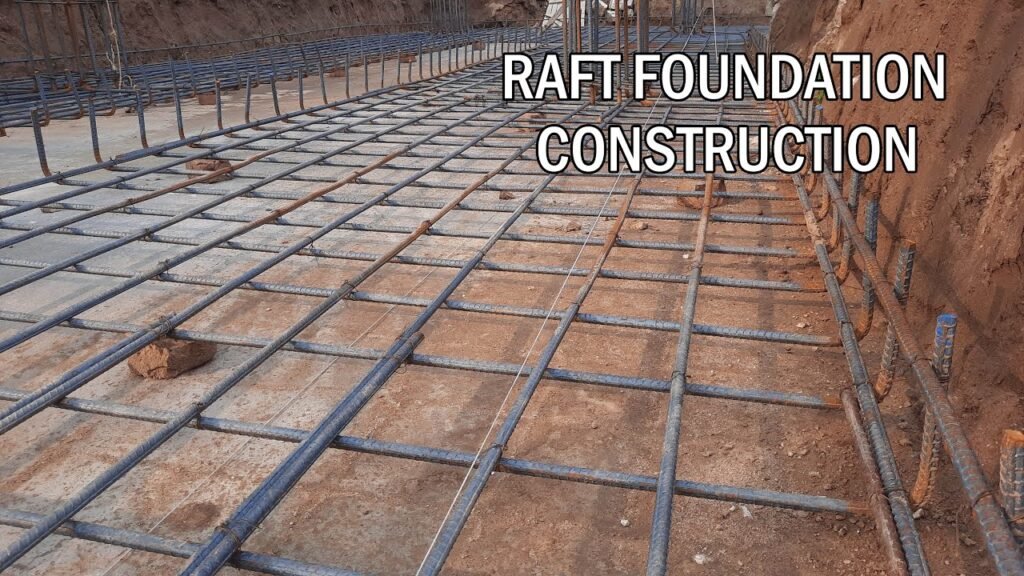
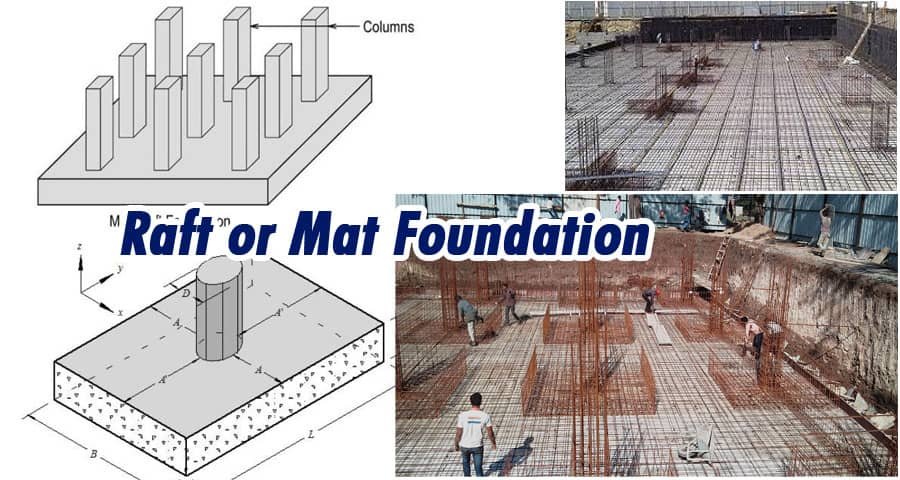
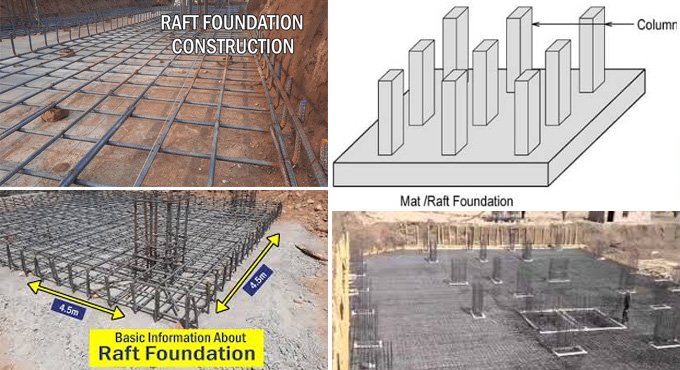
A Raft Foundation or Mat Foundation is a thick, reinforced concrete slab that extends over a large area of the ground and supports multiple columns and walls. Instead of using separate isolated footings under each column, the raft acts like one continuous mat that carries the entire building load.
This design spreads the load over a large area, reducing the stress on the soil underneath. It is most useful when:
- The soil bearing capacity is low.
- The building loads are heavy.
- Columns or walls are closely spaced.
- A basement or underground structure is planned.
In simple words, a raft foundation allows a building to “float” on the ground — much like a raft floats on water — by distributing the weight evenly.
Importance of Raft Foundation in India
In Indian construction, raft foundations are very common because of varying soil conditions. Many Indian cities, like Delhi, Kolkata, Mumbai, and Chennai, have soft alluvial or coastal soils. In such cases, isolated footings can settle unevenly.
Using a reinforced concrete raft foundation gives greater stability, reduces cracks in the structure, and ensures long-term performance. It is also easier to build in areas with a high groundwater table or limited working space, which is often the case in urban areas.
Main Components of a Raft Foundation
| Component | Description |
|---|---|
| Reinforced Concrete Slab | The main structural element that spreads loads. Thickness may vary from 300 mm to 1200 mm depending on design. |
| Reinforcement Bars | Steel bars placed in both directions to resist bending and shear. |
| Columns and Walls | Transmit building loads to the raft. |
| Sub-base / Blinding Layer | A lean concrete or sand layer below the raft for uniform support. |
| Waterproofing Layer | Prevents water seepage, especially in basements or wet areas. |
Advantages of Raft Foundation
Let’s explore in detail why engineers prefer raft foundations in many projects.
1. Uniform Load Distribution
The biggest advantage of a raft foundation is that it spreads loads uniformly over the entire footprint of the building.
This reduces the bearing pressure on the soil and prevents unequal settlement.
It is particularly beneficial when the soil has non-uniform strength or varying moisture conditions.
2. Reduced Differential Settlement
Because all columns and walls sit on a single mat, the movement of the structure remains consistent.
This minimizes cracks in walls, floors, and beams, which often happen due to differential settlement in isolated footing systems.
3. Ideal for Weak or Loose Soils
Raft foundations are very effective on soils with low bearing capacity such as clay, silt, or reclaimed land.
Instead of constructing deep pile foundations, a shallow raft can safely support the load when properly designed.
This makes it a cost-effective option in many Indian conditions.
4. Suitable for High Water Table Areas
In areas like Mumbai or coastal Chennai, where the groundwater table is high, excavation for isolated footings can be difficult.
A raft requires less excavation and acts as a watertight base slab when waterproofed correctly.
5. Acts as Floor Slab or Basement Slab
Another practical benefit is that the raft foundation can serve as the ground floor or basement slab.
This dual function saves time, materials, and labour.
It also provides a clean, strong surface for subsequent construction.
6. Economical for Closely Spaced Columns
When columns are close together, individual footings may overlap.
In such cases, a raft foundation becomes more economical and efficient because it eliminates the need for separate footings and connecting beams.
7. Suitable for Heavy Loads
Industrial buildings, storage tanks, or high-rise cores can exert heavy concentrated loads.
A raft distributes these loads evenly, ensuring better structural performance and stability.
8. Quick and Easy Construction
Raft foundations require less formwork and fewer joints compared to multiple isolated footings.
This makes them faster to construct, especially when prefabricated reinforcement mats are used.
9. Earthquake Resistance
When designed properly, a raft foundation behaves as a single integrated unit with the superstructure.
This provides better resistance against seismic forces, which is vital in earthquake-prone regions of India such as Delhi, Gujarat, and the Northeast.
10. Cost-Effective in the Long Run
Though the initial cost of a raft foundation may be slightly higher than individual footings, it saves money in the long term through reduced maintenance, lower repair needs, and faster construction.
Summary Table – Advantages of Raft Foundation
| Advantage | Practical Benefit |
|---|---|
| Uniform load spread | Reduces soil pressure and settlement |
| Suitable for weak soils | Avoids deep or pile foundations |
| Less excavation | Saves time and cost |
| Dual function as floor slab | Reduces structural thickness and cost |
| Minimizes differential settlement | Prevents cracks in structure |
| Faster construction | Simple formwork and reinforcement |
| Ideal for basements | Provides watertight floor and foundation |
| Better seismic performance | Acts as single rigid unit |
| Long-term durability | Low maintenance foundation |
Types of Raft Foundations
Different types of raft foundations are used depending on the load, soil type, and structure.
| Type of Raft Foundation | Description | Typical Use |
|---|---|---|
| Solid Slab Raft | A flat, solid concrete slab of uniform thickness. | Light structures or residential buildings. |
| Slab and Beam Raft | Beams cast in both directions with slab panels in between. | Medium to heavy buildings. |
| Cellular or Box Raft | Top and bottom slabs connected by walls forming box cells. | Heavy loads and basements. |
| Piled Raft Foundation | Combination of piles and raft to reduce settlement. | High-rise buildings, poor soils. |
| Raft with Pedestals | Columns rest on raised portions of raft for uniform stress. | Uneven loading conditions. |
Each type has its own advantages. The beam and slab raft is the most common in India due to its balance between strength and cost.
Raft Foundation vs Isolated Footings
| Parameter | Raft Foundation | Isolated Footings |
|---|---|---|
| Soil Requirement | Suitable for weak or variable soils | Suitable for strong uniform soils |
| Load Distribution | Shared by entire raft | Carried by individual footings |
| Settlement | Minimal differential settlement | Higher risk of uneven settlement |
| Excavation | Shallow and uniform | Multiple deep pits |
| Speed of Construction | Faster | Slower |
| Cost | Economical for large or heavy buildings | Cheaper for small structures |
Design Considerations for Raft Foundation
Designing a raft foundation requires understanding both structural and geotechnical aspects.
Key Design Steps
- Soil Investigation: Determine bearing capacity, water table, and settlement characteristics.
- Load Calculation: Compute loads from all columns and walls.
- Thickness Determination: Based on bending moment and shear forces.
- Reinforcement Detailing: Provide sufficient steel in both directions.
- Punching Shear Check: Especially under heavily loaded columns.
- Settlement Analysis: Ensure total and differential settlements are within permissible limits.
Common Design Parameters (for general guidance)
| Parameter | Typical Range |
|---|---|
| Raft Thickness | 300 mm to 1200 mm |
| Reinforcement Cover | 50 mm to 75 mm |
| Concrete Grade | M25 to M40 |
| Steel Type | Fe 500 or Fe 550 |
| Bearing Pressure | 100 kN/m² – 300 kN/m² |
These values vary with project type, soil condition, and structural load.
Construction Process of Raft Foundation
- Excavation: The ground is excavated to the required depth.
- Surface Preparation: The soil is leveled and compacted.
- Blinding Concrete: A thin layer of lean concrete (around 100 mm thick) is laid to create a clean surface.
- Waterproofing (if needed): A membrane or bitumen layer is applied in basement rafts.
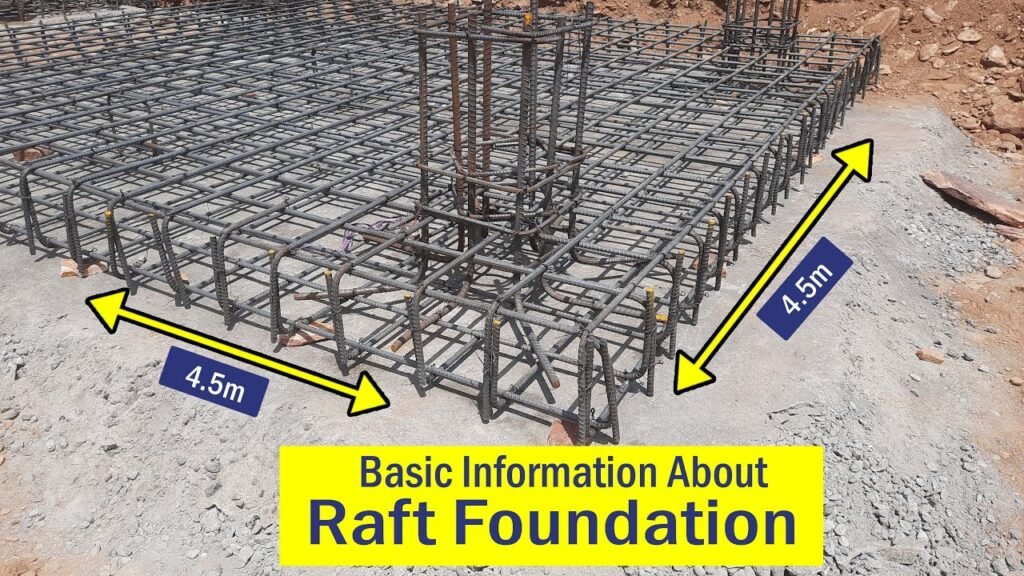
- Formwork and Reinforcement: Shuttering is installed and reinforcement bars are placed according to drawings.
- Concrete Pouring: Concrete is poured in one continuous operation to prevent cold joints.
- Curing: The concrete is kept moist for 7 to 14 days for proper strength gain.
- Backfilling: Once the raft gains sufficient strength, the sides are backfilled with suitable soil.
Maintenance and Durability Tips
- Apply protective coatings to prevent corrosion of reinforcement.
- Ensure proper drainage systems to avoid water accumulation.
- Perform regular inspections for cracks or settlement after construction.
- In basements, maintain waterproof membranes and check for leaks periodically.
Advantages of Raft Foundation in Indian Context
- Perfect for Alluvial Soils: Indian cities built on riverbeds (like Patna, Kolkata, and Ahmedabad) benefit greatly from raft foundations.
- Economical for Apartment Buildings: Multi-storey residential projects with many closely spaced columns find rafts cost-efficient.
- Excellent for Basements and Parking Floors: Common in Indian commercial complexes and malls.
- Reduces Construction Delays: Since the raft can be completed quickly, project timelines are shorter.
- Better Structural Integrity: Helps maintain stability in varying temperature and moisture conditions common in Indian climates.
Disadvantages of Raft Foundation (for Awareness)
While raft foundations have many advantages, they also have some limitations:
| Limitation | Description |
|---|---|
| High Initial Concrete Volume | Large quantities of concrete and steel required. |
| Difficult to Repair Later | Once poured, modifications are complex. |
| Not Ideal for Very Weak Soils | Extremely soft soils may still require piles. |
| Waterproofing Challenges | Especially in basements with high groundwater. |
Despite these, proper design and supervision can overcome most issues.
Practical Example – Typical Use Case in India
In a multi-storey apartment building in Delhi, the soil investigation shows a safe bearing capacity of 150 kN/m². The column loads are heavy and spacing is close. Constructing individual footings would cause overlapping and complex detailing.
Instead, the structural engineer designs a raft foundation 750 mm thick using M30 concrete and Fe 500 steel. The raft covers the entire building footprint. The design ensures uniform load distribution, minimal settlement, and cost savings.
This is a typical scenario in Indian building projects where raft foundations offer both technical strength and economic advantage.
Common Mistakes to Avoid
- Ignoring Soil Testing: Always perform a proper soil test before choosing a raft.
- Inadequate Waterproofing: Essential for basements and high water tables.
- Poor Concrete Curing: Can lead to cracks and weak concrete.
- Skipping Expansion Joints: Needed in large raft areas to reduce shrinkage stress.
- Insufficient Reinforcement Anchoring: Leads to weak spots near columns.
Frequently Asked Questions (FAQs)
1. What is the main advantage of a raft foundation?
It distributes building loads evenly over a large area, reducing soil pressure and preventing differential settlement.
2. Where is raft foundation used most commonly?
It is used in residential and commercial buildings, basements, and industrial projects, especially in areas with weak soils or high water tables.
3. Is raft foundation cheaper than piles?
Yes, for moderate-load buildings and shallow depths, raft foundations are more economical. Piles are used only when the top soil layers are extremely weak.
4. What is the typical thickness of a raft foundation?
Raft thickness generally ranges between 300 mm to 1200 mm depending on the load and soil type.
5. Does raft foundation need waterproofing?
Yes, if used below ground level or in waterlogged areas. Proper waterproof membranes prevent seepage and protect the structure.
6. Can a raft foundation be combined with piles?
Yes. This is known as a piled raft foundation, used for high-rise or heavy-load buildings.
7. How long does a raft foundation last?
With proper design and maintenance, it can last 50 years or more.
Conclusion
A Raft Foundation is one of the most practical and efficient shallow foundation systems in civil engineering.
It provides uniform load distribution, controls settlement, and reduces foundation costs in many projects.
For Indian soil conditions—where variability, moisture, and space constraints are common—it is an excellent solution.
By combining structural strength, economy, and speed of construction, the raft or mat foundation has become a trusted choice for engineers and builders across India.
With proper soil study, design, and construction supervision, a well-designed raft foundation ensures a stable, durable, and long-lasting structure for decades.