Modern architecture demands wide, open spaces with minimal columns and maximum strength. Structures like airport terminals, stadiums, shopping malls, and auditoriums often need large spans with light roofs. In such cases, a space frame structure becomes an ideal choice.
A space frame is a lightweight, three-dimensional structure that distributes loads evenly in all directions. It offers great strength, flexibility, and beauty. Engineers and architects use it to design efficient and visually appealing buildings. In India, space frame structures are becoming very popular because they are cost-effective, durable, and suitable for large-span roofs.
In this article, you’ll learn everything about space frame structures, including their definition, types, components, design methods, advantages, disadvantages, and applications in construction. The content is written in simple, short sentences for better understanding.
What is a Space Frame Structure?
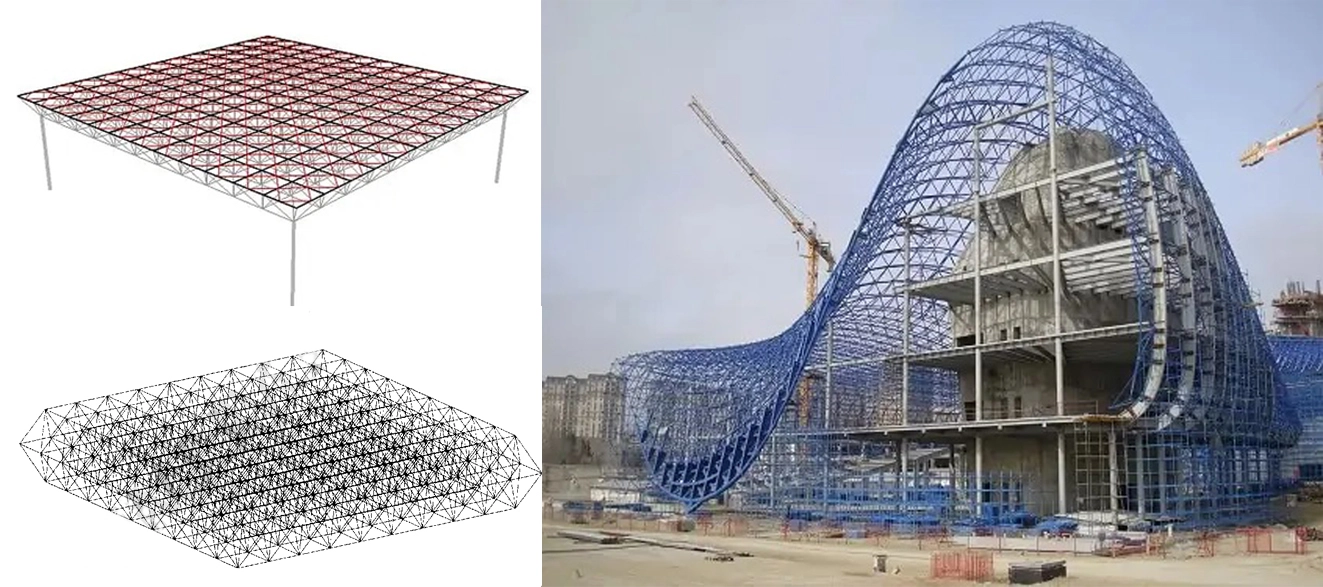
A space frame structure (also known as a space truss or 3D truss) is a three-dimensional structural system composed of interconnected linear members arranged in geometric patterns. These members meet at joints called nodes, forming a rigid framework.
The load in a space frame is shared among multiple members through axial tension and compression. Because of this triangulated configuration, the structure becomes extremely strong and stable, even with a minimal amount of material.
In simple terms, a space frame is like a “3D skeleton” made of steel or aluminum tubes that can span long distances without bending or sagging. It acts as a lightweight yet strong framework for roofs and domes.
Main Components of a Space Frame
The performance of a space frame depends on the quality and design of its components. The main elements are:
| Component | Description |
|---|---|
| Members (Struts / Tubes / Bars) | Linear steel or aluminum elements that carry axial forces. Usually made of circular or square hollow sections. |
| Nodes (Connectors) | Joints that connect members. They transfer forces and maintain geometric stability. |
| Top and Bottom Chords | Horizontal layers that resist compression and tension forces. |
| Diagonal Members | Connect top and bottom layers to provide depth and stiffness. |
| Bracing and Purlins | Secondary members to support roofing sheets or panels. |
| Roof Cladding / Panels | External coverings that protect against weather and complete the appearance. |
Characteristics of Space Frame Structures
- Three-dimensional load distribution: Space frames carry loads in three directions, unlike regular beams or trusses that carry loads in one plane.
- Lightweight and strong: Due to triangulation, they use less material without losing strength.
- Prefabricated and modular: Components can be manufactured off-site and assembled quickly.
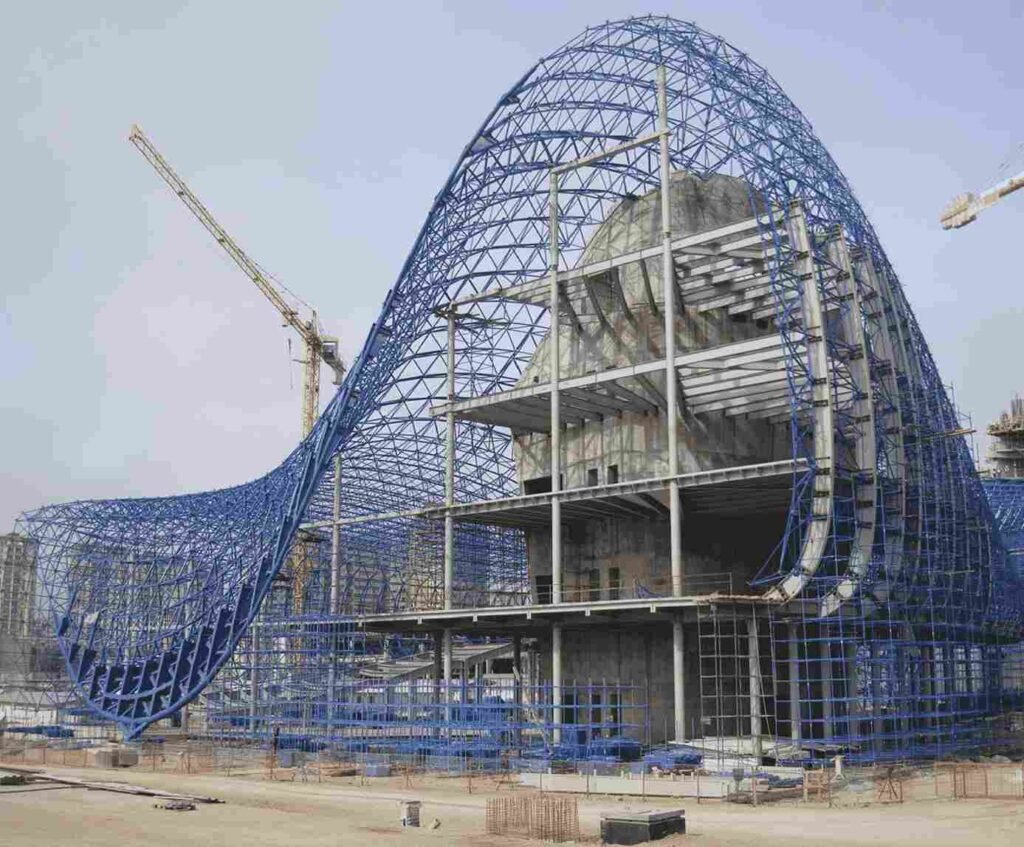
- Architectural flexibility: They can form domes, shells, and curved or flat roofs.
- Economical for long spans: Space frames can cover 30 to 150 meters or more without intermediate supports.
Types of Space Frame Structures
Space frames can be classified based on their layer arrangement and geometrical shape.
1. Classification Based on Layer Arrangement
| Type | Description | Common Uses |
|---|---|---|
| Single-Layer Space Frame | Members are arranged in a single plane. Suitable for small roofs or decorative structures. | Skylights, canopies, small halls |
| Double-Layer Space Frame | Two parallel layers connected by diagonal members. The most common type. Offers high stiffness. | Stadiums, airports, malls |
| Triple-Layer Space Frame | Three parallel layers of members. Extremely rigid but heavy and expensive. | Large industrial sheds, exhibition centers |
Double-layer space frames are the most widely used in India because they provide the best balance between strength, weight, and cost.
Also Read Hidden Beam in Construction: Meaning, Purpose, Design, and Advantages Explained
2. Classification Based on Geometric Shape
| Geometry Type | Description | Example Use |
|---|---|---|
| Tetrahedral | Made from tetrahedron-shaped units. Provides uniform stiffness. | Dome roofs |
| Octahedral | Made of octahedral modules that give strong, regular patterns. | Sports complexes |
| Geodesic | Formed from subdivided triangles on a sphere. Very stable. | Planetariums, auditoriums |
| Pyramidal / Diagonal Grid | Used for rectangular or square plan buildings. | Malls, factories |
Structural Behavior and Load Transfer in Space Frames
The behavior of a space frame structure is similar to that of a truss but in three dimensions. The load applied on the structure (such as wind, snow, or dead load) is distributed to various members.
Each member experiences axial tension or compression. Because of the triangulated geometry, no member undergoes bending moments, which makes space frames extremely efficient.
Load Path in a Space Frame:
- External loads (dead, live, wind) act on the top layer.
- The loads are transferred to the diagonal and bottom members.
- Finally, they pass to the columns or supports.
This three-dimensional load sharing gives high stiffness and minimizes deflection.
Materials Used in Space Frame Construction
| Material | Features | Common Use in India |
|---|---|---|
| Steel (IS 2062) | High strength, ductile, recyclable. Can be welded or bolted easily. | Most common for large spans. |
| Aluminium | Lightweight and corrosion resistant. More expensive. | Airport terminals, exhibition halls. |
| Stainless Steel | Excellent appearance and corrosion resistance. | Aesthetic public structures. |
| Timber or Glulam | Used for eco-friendly designs or temporary structures. | Small domes, architectural roofs. |
| Composite Materials | Used in experimental or lightweight structures. | Limited use in India. |
In India, structural steel space frames are most common because of availability, cost-effectiveness, and familiarity among fabricators.
Design of Space Frame Structures
Designing a space frame involves structural analysis, member sizing, node detailing, and load considerations.
Design Considerations
- Span and Geometry:
Decide shape (flat, dome, pyramidal) and number of layers based on span and architectural needs. - Load Calculation:
Include dead load, live load, wind load, and seismic load according to IS 875 and IS 1893. - Member Forces:
Analyze axial forces in tension and compression. - Buckling and Slenderness:
Compression members must satisfy slenderness limits as per IS 800. - Connection Design:
Nodes must safely transfer forces between members. - Deflection and Vibration:
Deflection should not exceed L/240 for roofs. - Durability and Corrosion:
Apply paint, galvanizing, or coatings for long-term protection. - Software Used:
STAAD Pro, SAP2000, and ANSYS are widely used in India for analysis.
Typical Design Parameters
| Parameter | Recommended Value / Range |
|---|---|
| Span | 30 m to 150 m |
| Depth (Double Layer) | 1/20 to 1/30 of span |
| Member Diameter | 50 mm to 150 mm |
| Connection Type | Bolted / Welded |
| Steel Grade | IS 2062 E250 or higher |
| Deflection Limit | L/240 to L/300 |
Connection and Node Systems
Nodes (joints) are the most critical part of any space frame. They ensure stability and accurate load transfer.
Common Types of Node Connections:
- Ball (Mero) Node System:
Uses a steel ball with threaded holes. Tubular members are bolted to the ball using special connectors. Provides excellent precision and aesthetics. - Plate Node System:
Uses steel plates welded or bolted to tubular members. Economical for medium spans. - Tubular or Cone Connectors:
Hollow cone-shaped fittings welded to members. Easy to fabricate locally. - Welded Joints:
Members welded directly at the node. Strong but requires precise fabrication.
Fabrication and Erection Methods
Space frames are usually prefabricated in factories and assembled on site.
This ensures accuracy and reduces construction time.
Common Erection Techniques:
| Method | Description | Best For |
|---|---|---|
| Module Assembly | Prefabricated modules are lifted and bolted together. | Medium-size projects |
| Block Assembly (Lift-up) | Entire sections are assembled on the ground and lifted using cranes. | Large roofs or domes |
| Scaffolding Method | Built in place using temporary supports. | Small structures |
| Cantilever Method | Sections are added progressively from supports. | When crane access is limited |
Proper alignment and torque tightening of bolts are essential to ensure structural integrity.
Cladding and Roofing Materials
Space frames can support a wide variety of roofing materials depending on the function and design of the building.
| Cladding Type | Material Examples | Common Use |
|---|---|---|
| Metal Sheets | Galvanized iron, aluminum sheets | Industrial sheds, malls |
| Glass Panels | Tempered glass | Skylights, atriums |
| Composite Panels | ACP, sandwich panels | Airports, showrooms |
| Fabric Membranes | PTFE, PVC-coated fabrics | Stadiums, tensile roofs |
Advantages of Space Frame Structures
| Advantage | Explanation |
|---|---|
| Large Clear Span | Covers wide areas without internal columns. Ideal for stadiums and airports. |
| Lightweight | Uses less material due to efficient load transfer. |
| Architectural Flexibility | Allows free-form shapes and curved roofs. |
| Prefabrication | Factory-made components ensure better quality and fast installation. |
| Aesthetic Appeal | Gives a modern and futuristic appearance. |
| Redundancy | Multiple load paths make the structure safe and reliable. |
| Reduced Foundation Cost | Lighter weight reduces footing sizes. |
Disadvantages of Space Frame Structures
| Disadvantage | Explanation |
|---|---|
| High Fabrication Cost | Complex joints and precise cutting increase cost. |
| Skilled Labor Required | Specialized fabrication and assembly skills needed. |
| Maintenance | Steel structures require regular painting and inspection. |
| Connection Complexity | Improper nodes can lead to instability. |
| Not Suitable for Small Spans | Economical only for medium to large structures. |
Applications of Space Frame Structures in India
Space frames are widely used in India for public and commercial buildings. Some common examples include:
- Airports: Terminal roofs (e.g., Delhi, Bengaluru)
- Stadiums: Sports complexes and domes
- Industrial Sheds: Large span factory roofs
- Malls and Showrooms: Aesthetic atrium spaces
- Auditoriums and Exhibition Halls: Column-free halls
- Petrol Pumps and Canopies: Light roof structures
Maintenance and Durability
For long life, space frames should be maintained properly.
Here are some key practices:
- Inspect all bolts and welds annually.
- Repaint or recoat steel members every 5–10 years.
- Check drainage systems to prevent water stagnation.
- Maintain expansion joints to allow thermal movement.
- Avoid drilling or cutting new holes in members during service life.
When maintained well, a steel space frame can last 50 years or more.
SEO Keywords to Integrate (for Online Publishing)
space frame structure, space frame design, types of space frame, steel space frame, double layer space frame, 3D truss system, space frame in construction, space frame architecture, space frame advantages, space frame connection, Indian construction technology, large span roof design, modular space frame, space frame components.
Frequently Asked Questions (FAQs)
1. What is the difference between a truss and a space frame?
A truss is two-dimensional, while a space frame is three-dimensional. A space frame distributes loads in all directions and can cover larger spans.
2. What is the ideal span for a space frame roof?
Space frames are economical for spans between 30 m and 150 m. Smaller spans can use simple trusses.
3. Which steel grade is used for space frame construction in India?
The most commonly used is IS 2062 E250 structural steel, suitable for welding and bolting.
4. How is a space frame constructed?
It is prefabricated in modules and assembled on-site using bolts or welds. The process is quick and clean.
5. Are space frames earthquake-resistant?
Yes. Because of their three-dimensional rigidity and load distribution, they perform well under seismic forces if designed as per IS 1893.
6. Do space frames need regular maintenance?
Yes. Steel structures need periodic inspection and painting to prevent corrosion.
7. Are space frames expensive?
The initial cost may be high, but overall savings in foundations, fast construction, and reduced maintenance make them economical in the long term.
Conclusion
A space frame structure is an advanced engineering system that combines strength, lightness, and beauty. Its 3D geometry enables large spans with minimal material. Space frames are ideal for modern Indian infrastructure — airports, stadiums, malls, and industrial buildings — where aesthetics and efficiency matter equally.
With improvements in fabrication technology and steel quality, space frames are becoming more accessible and cost-effective in India. They represent the perfect balance of engineering excellence and architectural creativity.
When designed and maintained properly, a space frame structure can provide decades of reliable service while enhancing the visual appeal of any building.