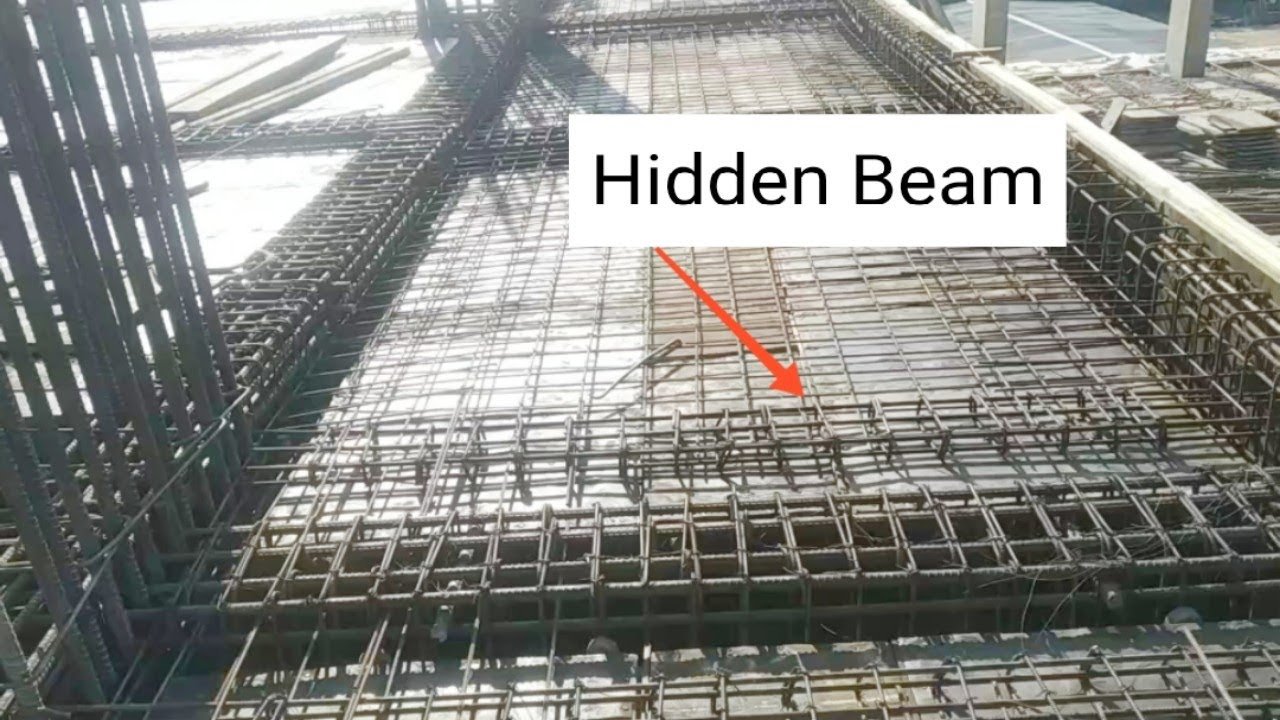
In modern building construction, smooth and aesthetic ceilings have become an important design element. Homeowners, architects, and builders prefer ceilings that look clean without any visible beam projections. To achieve this, engineers use what is known as a Hidden Beam or Concealed Beam.
A hidden beam is a structural member designed within the depth of a slab, making it invisible from below. It plays a key role in supporting loads and maintaining a flat ceiling surface. Hidden beams are very popular in residential, commercial, and office buildings in India.
This article explains everything about hidden or concealed beams — from their definition, design, and purpose to their advantages, disadvantages, construction process, and FAQs. It is written in simple English with short, clear sentences to increase readability.
What is a Hidden Beam (Concealed Beam)?
A Hidden Beam is a reinforced concrete beam provided within the thickness of a slab. It does not project below the ceiling level, so it remains invisible after finishing. The beam is cast monolithically with the slab and helps in carrying loads or dividing slab panels.
In simple words, a hidden beam is a beam that cannot be seen from the underside of the slab because it is embedded inside the slab itself. The ceiling looks flat and uniform, giving an aesthetic appearance.
Hidden beams are also called:
- Concealed beams
- Flat slab beams
- Integrated slab beams
Purpose of Providing Hidden Beams
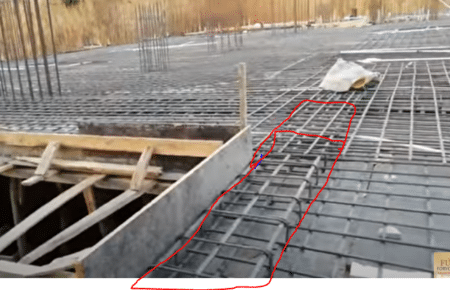
Hidden beams are used in reinforced concrete structures mainly for the following purposes:
- To support partition walls resting on slabs.
- To reduce slab thickness by dividing it into smaller panels.
- To carry concentrated loads without disturbing ceiling aesthetics.
- To achieve a flat ceiling where false ceilings are not desired.
- To increase stiffness and reduce deflection in large slab panels.
- To improve load transfer between columns and slabs.
Hidden beams are especially useful in buildings where floor-to-floor height is limited and visible drop beams are not preferred.
Hidden Beam vs Drop Beam vs Inverted Beam
| Feature | Hidden / Concealed Beam | Drop Beam | Inverted Beam |
|---|---|---|---|
| Position | Within slab depth | Below slab | Above slab |
| Ceiling Type | Flat and smooth | Projected / stepped ceiling | Flat from below, raised above |
| Purpose | Aesthetic, wall load transfer | Strength and long spans | To support roof slabs or decks |
| Appearance | Invisible | Visible | Invisible from below |
| Common Use | Residential & offices | Heavy load areas | Roofs, terraces, tanks |
Hidden beams provide beauty and simplicity, while drop beams and inverted beams focus more on strength and capacity.
Structural Behavior of Hidden Beams
Even though hidden beams are not visible, they behave just like normal reinforced concrete beams. They resist bending moments, shear forces, and deflection. However, since their depth is limited to slab thickness, their strength is lesser compared to regular beams.
Hidden beams are designed carefully to ensure:
- Adequate flexural strength (bending resistance).
- Enough shear strength to prevent cracking.
- Proper bond and anchorage of reinforcement.
- Compatibility with slab bending behavior.
In essence, a hidden beam acts as a strengthened strip within a slab, designed to carry higher loads or distribute wall loads efficiently.
Also Read Rat Trap Bond of Brick: The Smart and Sustainable Brickwork Method in India
Design Considerations for Hidden Beams
Hidden beams require careful design because of their shallow depth and integration with slabs. Engineers must consider the following factors:
- Depth Limitation
The beam depth is the same as slab thickness (usually 120–200 mm). Therefore, the bending and shear capacity are limited. - Span-to-Depth Ratio
Since the depth is less, hidden beams are suitable for shorter spans (up to 3.5–4.5 m). - Reinforcement Design
Both top and bottom reinforcement are provided. Stirrups are placed closely to control shear cracks. - Anchorage
Bars must be anchored properly into the supporting column or adjacent beam. - Deflection Control
Serviceability limits must be checked because deflection can be more in concealed beams. - Compatibility with Slab
The slab and beam must act together structurally. Reinforcement layout should be continuous across the slab-beam system. - IS Code Reference
In India, hidden beams are designed as per IS 456:2000, following the limit state design method.
Construction Process of Hidden Beams
Hidden beams are constructed along with the slab in one monolithic pour. Below are the main steps involved in their construction:
- Formwork Preparation
The shuttering for the slab and hidden beam is set together. The beam is kept within slab thickness. - Reinforcement Placement
Beam bars, stirrups, and slab mesh are placed according to the structural drawing. Proper cover blocks are used. - Provision for Services
Openings for electrical and plumbing conduits are made before concreting to avoid later cutting. - Concreting
Concrete is poured for the slab and hidden beam together. Proper vibration ensures compaction and strength. - Curing
The entire slab is cured for at least 7 days to gain required strength and minimize cracking. - Finishing
The ceiling below remains flat, requiring minimal plastering or false ceiling.
Typical Reinforcement Details of Hidden Beams
| Component | Specification (Typical) |
|---|---|
| Slab Thickness | 150 mm to 200 mm |
| Beam Width | 230 mm to 300 mm |
| Bottom Bars | 2–4 bars of 10–16 mm dia |
| Top Bars | 2 bars of 8–12 mm dia |
| Stirrups | 8 mm dia @ 100–150 mm c/c |
| Concrete Grade | M20 or M25 |
| Cover | 20–25 mm |
These values are indicative. Actual design should be verified by a qualified structural engineer depending on load conditions.
Advantages of Hidden Beams
| Benefit | Description |
|---|---|
| Flat Ceiling Finish | Provides smooth surface without visible beams. |
| Increased Headroom | Useful in areas with limited floor-to-floor height. |
| Better Aesthetics | Gives modern and elegant look to interiors. |
| Efficient Load Distribution | Transfers loads from walls or slabs effectively. |
| Simplified Lighting Layout | No obstructions for light fixtures or ceiling fans. |
| Reduced False Ceiling Cost | No need to hide drop beams with gypsum or POP. |
Hidden beams are particularly useful in residential apartments, office spaces, hotels, and commercial complexes where aesthetics are crucial.
Disadvantages of Hidden Beams
| Limitation | Explanation |
|---|---|
| Reduced Depth | Limits bending and shear strength compared to drop beams. |
| Higher Reinforcement Congestion | Can be difficult to place bars and stirrups within limited thickness. |
| Complex Construction | Requires skilled labor and proper formwork alignment. |
| Difficult Quality Control | Honeycombing or poor compaction cannot be seen easily. |
| Not Suitable for Long Spans | Best used for short spans or light loads. |
Hidden Beams in Earthquake Zones
In earthquake-prone regions of India, such as Zone III, IV, and V, hidden beams should be used cautiously.
- Concealed beams reduce the structural depth and may affect seismic performance.
- Engineers must ensure proper ductile detailing, column-band connections, and reinforcement continuity.
- It is advisable to use visible drop beams or RCC bands for better seismic resistance in multi-storey buildings.
Proper compliance with IS 13920 (Ductile Detailing Code) is necessary for earthquake safety.
Applications of Hidden Beams in Indian Construction
Hidden beams are widely used in:
- Residential buildings for smooth ceiling and wall alignment.
- Commercial offices to hide electrical and HVAC ducts.
- Hotels and auditoriums for aesthetic interiors.
- Hospitals and schools where false ceilings are not preferred.
- Architectural spaces that require minimalist design.
They are also provided below partition walls or masonry dividers resting on slabs to avoid cracks or deflection.
Cost and Maintenance of Hidden Beams
Hidden beams may slightly increase construction cost due to more reinforcement and formwork precision. However, they save money on false ceiling installation and finishing work.
In the long run, they reduce maintenance needs because the ceiling surface remains clean and free from visible cracks around drop beams.
Hidden Beam vs Flat Slab — What’s the Difference?
| Feature | Hidden Beam System | Flat Slab System |
|---|---|---|
| Structural Element | Beam embedded in slab | No beams, slab rests directly on columns |
| Load Transfer | Slab → Beam → Column | Slab → Column |
| Thickness | 150–200 mm | 200–300 mm |
| Ceiling Type | Flat | Flat |
| Best For | Short spans, aesthetics | Long spans, heavy loads |
| Design Complexity | Moderate | High (punching shear control needed) |
Hidden beams are like a hybrid system — they maintain a flat ceiling like a flat slab but include hidden reinforcement bands for extra support.
Practical Tips for Site Engineers and Builders
- Always check drawings carefully before bar bending.
- Maintain proper clear cover using spacers.
- Do not cut reinforcement bars for electrical or plumbing conduits.
- Ensure monolithic concreting of slab and beam.
- Use good vibration to avoid voids and honeycombing.
- Curing must be done properly to reduce shrinkage cracks.
- For large spans or heavy walls, consult a structural engineer for additional design checks.
SEO Keywords to Integrate
Hidden beam in construction, concealed beam meaning, hidden beam design, hidden beam vs drop beam, hidden beam advantages, concealed beam reinforcement, flat ceiling beam, RCC hidden beam, hidden beam in slab, concealed beam in India, slab beam detailing, concealed beam thickness, hidden beam cost, hidden beam structural design.
Frequently Asked Questions (FAQs)
1. What is the difference between a hidden beam and a normal beam?
A hidden beam lies within slab depth and is invisible from below. A normal beam projects below the slab and is clearly visible.
2. Is a hidden beam strong enough to carry walls?
Yes, if designed properly. Hidden beams can safely carry light partition walls or masonry loads resting on slabs.
3. Can hidden beams be used in multi-storey buildings?
Yes, but they should be used carefully with proper seismic detailing and RCC bands.
4. What is the ideal span for hidden beams?
Hidden beams are suitable for spans between 3.0 m to 4.5 m. Longer spans require deeper beams.
5. Do hidden beams increase construction cost?
Slightly yes, because of higher reinforcement and careful formwork. However, they reduce finishing and false ceiling costs.
6. Which IS Code is used for hidden beam design in India?
Hidden beams are designed according to IS 456:2000 (for RCC design) and IS 13920:2016 (for ductile detailing in seismic areas).
7. Is a hidden beam necessary in every slab?
No. Hidden beams are used only where additional support or flat ceiling is required.
Conclusion
A Hidden Beam, also known as a Concealed Beam, is an innovative structural element that allows engineers and architects to design flat, elegant ceilings without compromising load-bearing capacity. It helps in transferring loads from walls and slabs efficiently while maintaining aesthetics.
In India, hidden beams are commonly used in residential, commercial, and institutional buildings where appearance and space optimization are important. However, they must be designed carefully considering depth, reinforcement, and seismic safety.
If used correctly, hidden beams can balance both strength and style, making them a smart choice for modern construction projects.