In modern construction, people look for ways to save money, reduce material use, and build energy-efficient homes. One technique that helps achieve all of these goals is the Rat Trap Bond of Brick.
This brickwork method is not new, but it has gained fresh attention in India for its cost savings, eco-friendly nature, and thermal comfort benefits. It combines traditional brick masonry with smart engineering.
This article explains what Rat Trap Bond is, how it works, how it is constructed, its advantages, limitations, and where it is best used. You will also learn how it compares with other bonds, how much it can save in cost, and what precautions are needed. The language here is simple and easy to understand — ideal for students, engineers, and homeowners.
What is Rat Trap Bond of Brick?
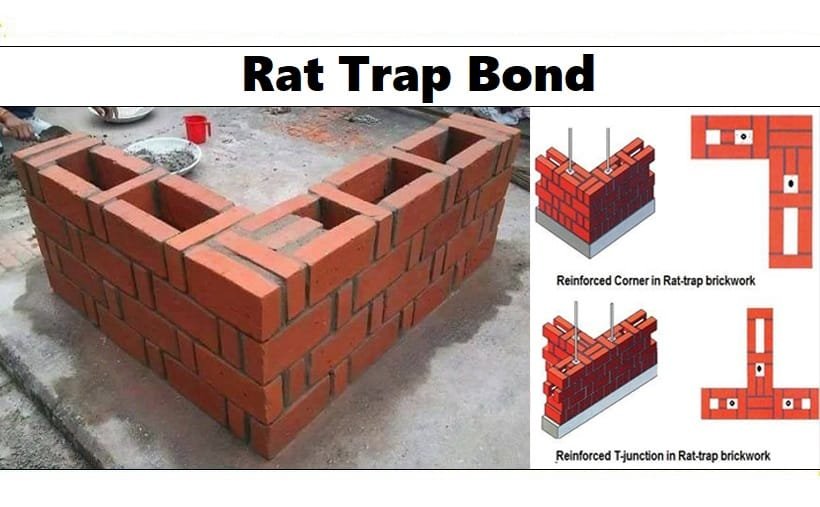
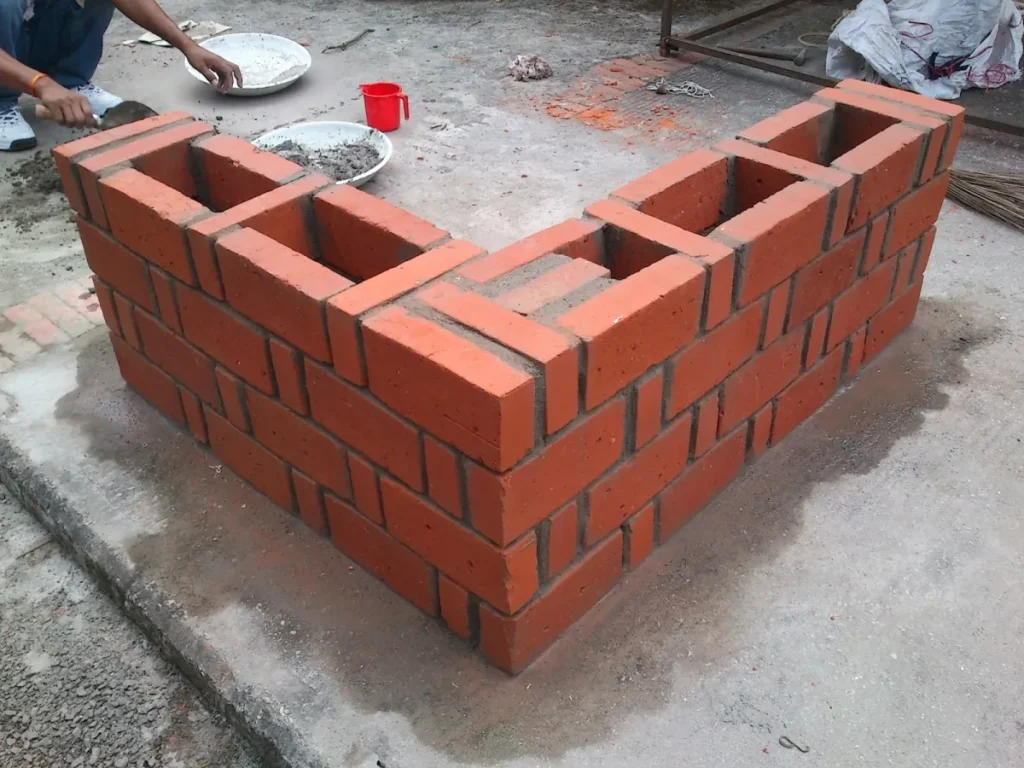
The Rat Trap Bond is a special brick masonry technique where bricks are placed on their edge instead of flat.
This creates a series of vertical cavities or hollows within the wall. These hollows trap air, which acts as an insulator and reduces heat flow through the wall.
In this method, both the outer and inner faces of the wall are made up of brick surfaces, while the hollow cavity runs continuously inside the wall.
This cavity reduces the number of bricks and mortar needed while maintaining the wall’s strength and stability.
A wall built with a Rat Trap Bond looks just like a normal brick wall from the outside. However, the inside has an intelligent arrangement of bricks that saves material and improves thermal performance. It is also called an energy-efficient brick masonry system or eco-friendly wall construction technique.
Origin and Use in India
The Rat Trap Bond technique has existed for over a century in some countries.
In India, it was popularized by architects and engineers promoting cost-effective housing and sustainable construction methods.
This bond became especially well-known through Laurie Baker, a British-born Indian architect famous for his work in low-cost housing. He introduced Rat Trap Bond to Kerala and other parts of India as part of his sustainable design philosophy.
Today, many architects and civil engineers recommend Rat Trap Bond for affordable housing, green buildings, and residential construction projects.
Government housing missions and non-profit organizations have also recognized its value in saving energy and materials.
How Rat Trap Bond Brickwork Looks
Imagine a brick wall where each brick stands on its long narrow edge instead of lying flat.
The bricks are arranged in such a way that you can see both their longer and shorter faces alternately on the wall surface.
Between the two faces of bricks, a hollow vertical cavity runs through the height of the wall.
This cavity is the “rat trap” — it traps air inside and makes the wall thermally efficient.
From the outside, it looks like a regular brick wall, but inside, it’s a clever system of air pockets and interlocked bricks.
Why It’s Called “Rat Trap” Bond
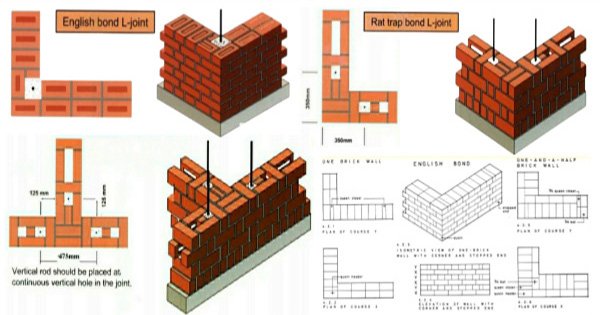
The name “rat trap” comes from the appearance of the hollow space created inside the wall.
If you look at a cross-section of the wall, the cavity resembles a narrow tunnel where a small animal could pass through.
It is just a descriptive term — no actual rats live inside!
This unique cavity is what gives the bond its energy-saving and cost-saving features.
Also Read Fascia in Construction: Types, Functions, Materials, Installation, and Importance in Building Design
Step-by-Step Construction Process of Rat Trap Bond
Let’s go through the typical steps followed by masons during rat trap bond brickwork:
1. Foundation and Plinth
The foundation and plinth are built using conventional solid brick masonry.
This provides a stable base. The first few layers of bricks above the plinth are also kept solid to support the hollow walls above.
2. Laying the First Course
The first course is laid with bricks on edge (their longer face vertical).
The arrangement alternates between shiners (long face visible) and rowlocks (short face visible).
The spacing between these creates the hollow cavity.
3. Maintaining the Cavity
The vertical cavity should be uniform — usually equal to the thickness of one brick.
Proper line and level must be maintained using a plumb line and string.
4. Tying the Two Faces
At regular intervals, a header brick (placed across the wall thickness) connects the two faces of the wall.
These tie bricks ensure structural stability and prevent the two layers from separating.
5. Mortar Application
Mortar is applied carefully only along the edges of the bricks.
The hollow cavity should not get filled with mortar.
Common mortar ratio used is 1:6 (cement:sand) or as per structural design.
6. Lintels and Bands
For door and window openings, provide reinforced concrete lintels or tie beams.
RCC bands at plinth, lintel, and roof levels improve strength and seismic resistance.
7. Plastering or Finishing
After the wall is complete, it can be plastered on both sides.
If you prefer an exposed brick look, seal the cavities properly to prevent pests or water entry.
Technical Dimensions and Brick Size
| Specification | Typical Value (India) |
|---|---|
| Common brick size | 230 × 110 × 75 mm |
| Wall thickness (nominal) | 230 mm (9 inches) |
| Cavity width | About 100 mm |
| Bricks per square meter | 85–95 bricks/m² |
| Mortar savings | 25–35% compared to solid bond |
| Brick savings | 20–30% compared to solid masonry |
The exact numbers may vary slightly depending on the region and the brick manufacturer.
Structural Strength and Safety
Many people worry whether rat trap bond walls are strong enough.
Several studies and experiments have shown that rat trap bond walls have sufficient strength for low-rise residential buildings when constructed properly.
When the bond is executed with good-quality bricks, correct mortar mix, and skilled workmanship, it can safely support one- or two-storey houses.
For larger buildings or seismic zones, additional reinforced concrete bands and vertical reinforcements should be provided.
The load-carrying capacity of Rat Trap Bond is comparable to that of traditional English bond walls of the same thickness, provided the cavities are continuous and properly aligned.
Thermal and Acoustic Performance
One of the greatest advantages of the Rat Trap Bond brick wall is its thermal insulation.
The air trapped inside the vertical cavities reduces heat transfer.
This keeps interiors cooler in summer and warmer in winter — perfect for India’s tropical climate.
This means lower electricity bills for air conditioning or fans and better comfort for residents.
In studies, temperature differences of 2–4°C have been recorded between rat trap bond and solid brick walls.
However, in terms of sound insulation, the hollow wall performs slightly lower than a solid wall.
Plastering both sides or adding insulation panels can easily solve this issue.
Advantages of Rat Trap Bond Brickwork
| Advantage | Description |
|---|---|
| Material Savings | Uses 20–30% fewer bricks and 25–35% less mortar. This reduces cost and weight of the structure. |
| Thermal Comfort | Hollow cavities act as insulation and reduce heat gain, making homes energy-efficient. |
| Cost-Effective | Reduces construction cost due to lower brick and mortar consumption. |
| Eco-Friendly | Less material means less embodied energy and reduced carbon footprint. |
| Ease of Service Installation | Electrical conduits and plumbing pipes can pass through cavities easily. |
| Aesthetic Appearance | If left exposed, the alternating shiners and rowlocks give a decorative look. |
| Lightweight Walls | The walls are lighter, putting less load on the foundation. |
Limitations of Rat Trap Bond
| Limitation | Description |
|---|---|
| Skilled Labour Required | Masons must be trained properly; wrong placement can weaken the wall. |
| Sound Insulation | Hollow spaces reduce soundproofing; plastering improves it. |
| Not Ideal for High-Rise | Suitable for low-rise buildings (1–2 storeys). Multi-storey requires structural design. |
| Pest and Moisture Risk | If cavities are open or unsealed, they can attract pests or trap water. |
| Quality Control Needed | Uneven bricks or poor mortar joints can reduce bond strength. |
Best Applications in India
Rat Trap Bond is best used in the following construction types in India:
- Low-cost residential houses
- Rural and semi-urban housing projects
- Eco-friendly or green buildings
- Partition and non-load-bearing walls
- Government housing schemes
- Institutions promoting sustainable architecture
It is less suitable for very tall or heavy-load structures unless proper reinforcement and engineering design are applied.
Cost Analysis of Rat Trap Bond Brickwork
To understand the savings, let’s compare the Rat Trap Bond with traditional English Bond:
| Item | English Bond (per m²) | Rat Trap Bond (per m²) | Savings |
|---|---|---|---|
| Bricks used | 120–130 | 85–95 | 25–30% |
| Cement used | 10–12 kg | 7–8 kg | 25–35% |
| Sand used | 0.04 m³ | 0.03 m³ | 25% |
| Overall wall cost | ₹800–₹900 | ₹600–₹700 | ~25% reduction |
These are approximate values that may vary based on region, labour rate, and material quality.
Still, this bond consistently proves to be one of the most cost-effective brick masonry options.
Quality Control Tips
- Use good-quality bricks with sharp edges and uniform size.
- Ensure consistent mortar thickness of about 10–12 mm.
- Check vertical alignment using a plumb line for each course.
- Provide RCC bands at lintel and roof levels for seismic safety.
- Seal cavities properly if walls are exposed.
- Avoid filling cavities with mortar, as that defeats the purpose of the design.
- Train masons before starting large-scale work.
Sustainability and Green Building Perspective
The Rat Trap Bond of Brick fits perfectly into the goals of sustainable construction in India.
It conserves natural resources by reducing the number of bricks burned in kilns, which directly reduces carbon emissions.
It also cuts down on cement and sand usage — two materials with high environmental impact.
Additionally, the walls provide natural insulation, reducing the need for energy-based cooling or heating systems.
This makes it an ideal choice for green housing projects, eco-friendly schools, and low-energy buildings across India.
Comparison: Rat Trap Bond vs English Bond
| Feature | Rat Trap Bond | English Bond |
|---|---|---|
| Brick placement | On edge | Flat |
| Cavity | Yes (air gap) | No |
| Thermal insulation | High | Moderate |
| Brick quantity | Fewer (20–30% less) | More |
| Mortar quantity | Less (25–35% less) | More |
| Strength | Sufficient for low-rise | Stronger overall |
| Skill needed | High | Moderate |
| Cost | Lower | Higher |
| Eco-friendliness | Excellent | Moderate |
From this comparison, it is clear that Rat Trap Bond is a smart and sustainable option for low-rise, affordable housing where thermal comfort and cost savings are important.
Frequently Asked Questions (FAQs)
Q1. Is Rat Trap Bond suitable for earthquake-prone areas?
Yes, but only if RCC bands and tie columns are properly provided at lintel, plinth, and roof levels. These bands enhance strength and make the wall earthquake-resistant.
Q2. Can Rat Trap Bond walls be left unplastered?
Yes, but only if the wall is properly sealed. Otherwise, the cavities may allow moisture or pests to enter. Most Indian builders prefer plastering both sides.
Q3. Does Rat Trap Bond require special bricks?
No. Ordinary modular bricks can be used, but they must be of uniform size and good quality to maintain accurate alignment.
Q4. Is Rat Trap Bond faster to construct?
Initially, it may take more time since masons need training. Once they gain experience, it becomes as fast as traditional brickwork.
Q5. What is the life span of Rat Trap Bond walls?
With proper construction and maintenance, the lifespan is equal to any other brick masonry wall — typically several decades.
Q6. Can this bond be used with reinforced concrete frames?
Yes. Rat Trap Bond can serve as infill wall panels in RCC-framed structures, reducing weight and improving thermal performance.
Conclusion
The Rat Trap Bond of Brick is one of the most intelligent and sustainable methods of brick masonry.
It provides the strength of a conventional wall while using fewer materials.
The hollow cavities improve insulation and make buildings cooler, which is a major benefit in India’s hot climate.
By adopting this method, builders and homeowners can reduce costs, save resources, and promote green construction without compromising on strength or durability.
However, success depends on skilled workmanship, proper detailing, and good quality materials.
With awareness and training, Rat Trap Bond can play a major role in India’s goal of building affordable, energy-efficient, and eco-friendly homes for all.