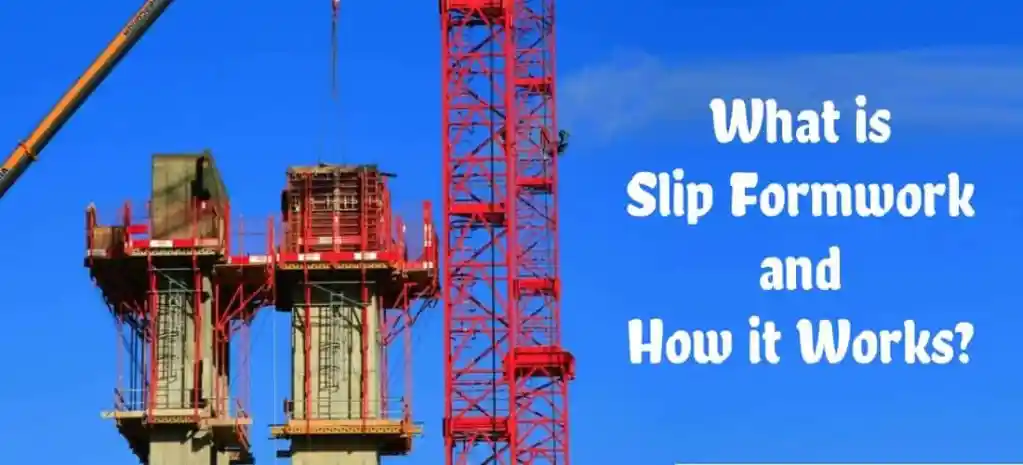
Slip formwork (also called slipforming) is a high-speed method to cast concrete continuously.
A moving form rises slowly as fresh concrete is poured.
The result is a monolithic, joint-free concrete element.
It is used for towers, chimneys, silos, bridge piers, cores of high-rise buildings, and long pavements. Wikipediatheconstructor.org
This article explains slip formwork in plain language.
You will learn how it works, where it’s best used, design and mix needs, equipment, workflow, advantages and limits, costs and productivity, safety and quality checks, plus India-focused tips.
Short paragraphs and simple sentences improve readability.
There are practical tables, a step-by-step guide, and FAQs at the end.
Quick overview: what is slip formwork?
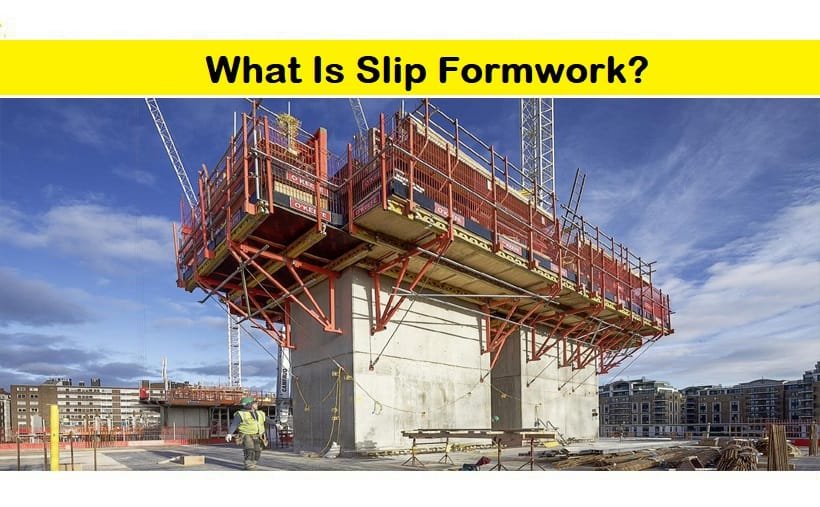
Slip formwork is a moving, self-climbing formwork system.
Concrete is poured continuously into the top of the form.
Hydraulic jacks or jacking rigs raise the form at a controlled rate.
The rate matches the concrete’s early strength gain so the bottom of the newly formed section supports itself.
This creates a seamless, homogenous concrete structure without cold joints. WikipediaConcrete Centre
There are two main modes:
- Vertical slipforming — used for towers, chimneys, shafts, and high-rise cores.
- Horizontal slipforming (pavers) — used for continuous pavements, medians, and curbs. theconstructor.orgapolloinffratechblog.apolloinffratech.com
Why contractors choose slipforming
Slip forming is gaining ground because it is fast and consistent.
Continuous casting removes repetitive cycle time involved in building, stripping and re-erecting formwork.
Structures go up without cold joints.
This improves durability and reduces waterproofing or plaster work. NBMCWdoka.com
Key benefits at a glance:
| Benefit | Why it matters |
|---|---|
| High speed | Many metres of structure per day; ideal for large volume work |
| Monolithic finish | No construction joints; stronger and less leak-prone |
| Less scaffolding & crane work | Forms climb on themselves; reduces crane cycles |
| Better surface quality | Smooth, uniform finishes; less rework |
| Safer platform | Workers operate on a single moving platform rather than tall temporary scaffolds |
These benefits make slipforming cost-effective on repetitive vertical or long horizontal works. BFS Industriesajbuildscaffold.com
Also Read Budget Breakdown: 1000 Sq. Ft House Construction Cost in India
Typical applications
Slip formwork is suited to structures that are repetitive in cross-section or very tall/long. Typical uses include:
- Chimneys and stacks.
- Silos and storage bins.
- High-rise core walls, lift shafts and stair shafts.
- Bridge piers and columns.
- Cooling towers and shafts.
- Tunnel linings and shaft linings.
- Airport runway and highway concrete paving (using slipform pavers). WikipediaConcrete Slipform Constructionapolloinffratechblog.apolloinffratech.com
In India, slipforming is used for highway paving, tall chimneys, telecom towers, and the cores of high-rise buildings. It is also common in industrial plants and large drainage works. constrosystems.inapolloinffratechblog.apolloinffratech.com
Types of slip formwork
There are several forms depending on shape and requirement.
| Type | Use case |
|---|---|
| Cylindrical slipform | Chimneys, silos, circular towers |
| Rectangular slipform | Building cores, elevator shafts |
| Tapered slipform | Cooling towers, tapered chimneys |
| Horizontal slipform paver | Roads, pavements, curbs |
| Special shapes (egg, conical) | Architectural towers and special structures |
Tapered or complex shapes require careful form design and tighter control of lift rates. ConstroFacilitatorZolo Construction Materials
Key components and equipment
A slipforming rig typically includes:
- Slipform panels / shutters — the actual mould that shapes the concrete.
- Hydraulic jacks and jacking frame — to lift the form uniformly.
- Working platform — secured to the form for placing reinforcement and concrete.
- Hydraulic power pack — supplies oil to the jacks.
- Concrete placing system — pump, hoppers, or conveyors.
- Vibrators — internal or external to consolidate concrete inside the moving form.
- Guides and rails — to keep the form vertical and aligned.
- Winches and bolting system — for temporary anchorage and adjustments.
A good slipform vendor also provides control panels, sensors, and monitoring instruments to regulate climb speed. SRG Globaldoka.com
Concrete mix and setting time: the tradeoff
Slipforming needs a special mix.
Concrete must be workable for placing and consolidation.
It must also gain enough early strength quickly so the lower part can support the loads and the form.
This requires a balance between workability and green strength.
Key mix considerations:
- Use a moderate to low water-cement ratio with superplasticisers for workability without excess bleed.
- Include accelerating admixtures carefully in cold weather to speed early strength.
- Use well-graded aggregates to limit segregation.
- Control slump tightly; too soft and the form will deform; too stiff and consolidation becomes poor.
- Adjust vibration strategy: internal vibrators or external vibration panels must be tuned so they compact concrete without causing form movement. theconstructor.orggbr.sika.com
Concrete temperature, season, and cement type affect the rise rate. The slip rate is set considering these factors and monitored continuously.
Design and planning: not a last-minute decision
Slip formwork must be planned from the design stage.
You must coordinate structural design, reinforcement detailing, and form geometry early.
Key planning aspects:
- Cross-section uniformity: Slipforming works best where cross-section repeats over height or length.
- Openings and service ducts: Pre-install block-outs for windows, openings and embedments.
- Stair and lift tolerances: For cores, openings for stairs and lifts need precise steel detailing.
- Joints and inserts: If a large opening interrupts slipforming, plan construction joints or chase areas.
- Form detailing: Provide chamfers, reveals and inserts into the form design to avoid later finishing.
- Scheduling: Slipforming often runs 24/7 to avoid cold joints. Arrange crews and logistics accordingly. Concrete CentreCiviconcepts
A detailed method statement and mock-up run are highly recommended before full-scale work.
Step-by-step slipform process (vertical case)
Below is a simplified sequential workflow for vertical slipforming:
- Set base slab and alignment. Make a perfect base level slab to start the form.
- Erect starter forms and guides. Fix guide rails and anchor the initial form.
- Place reinforcement and service embeds. Install rebar and sleeves ahead of the pour.
- Begin continuous concrete placing. Use pumps or hopper discharge to place concrete into the moving form.
- Consolidate inside form. Vibrate concrete using internal or external vibrators.
- Operate hydraulic jacks. Raise the form incrementally at a controlled speed (mm/hour) that matches concrete setting.
- Perform finishing operations. Trowel or float surfaces as needed immediately after form passes.
- Monitor quality and make adjustments. Temperature, slump and climb rate are checked constantly.
- Install any anchors or fixtures as required. Bolt or embed items as the structure grows.
- Complete to design height and demobilise. At top levels, form may be removed and slab finished conventionally. SRG Globalgbr.sika.com
A successful slipform pour is a continuous, well choreographed activity.
Productivity and speed: how fast can you go?
Slipforming is fast compared with conventional jumpform or modular formwork.
Typical production rates (these vary by structure and mix):
- Chimney / circular stacks: 0.5 m to 3+ m per day depending on size and resources.
- Building cores (smooth, repetitive cores): several meters per day; cores of tall buildings have been built at rates up to 3–6 m/day in favourable conditions.
- Highways (slipform pavers): kilometres per day for long stretches, with automated pavers setting out thickness and width precisely. WikipediaNBMCW
Speed depends on crew, equipment, mix, and weather. Continuous 24/7 operations maintain momentum and reduce cold-joint risk.
Cost implications
Slipforming has higher initial equipment and planning cost.
However, for large or repeated works the net cost often becomes lower because:
- Labour is reduced.
- Crane and scaffolding needs shrink.
- Cycle time per metre reduces significantly.
- Finishing and plaster costs often reduce because of good surface quality.
A simple cost comparison for a tall core or chimney usually shows slipforming becomes economical beyond a certain height. For one-off small shafts, traditional formwork can still be cheaper. Equipment hire or subcontractor rates must be included in tendering. ajbuildscaffold.combe-con.com
Common technical challenges
Slipforming is powerful but not trivial. Here are common issues and how to avoid them:
- Rate mismatch (climb too fast): If the form rises too quickly the freshly formed concrete will slump. Control by slowing the hydraulic jacks and/or adjusting the mix.
- Segregation or honeycombing: Poor mix design or excessive vibration can cause segregation. Use proper gradation and optimized vibration.
- Form alignment drift: Poor guide rails can lead to out-of-plumb elements. Provide robust guides and frequent checks with plumb lines or laser.
- Cold joints due to stoppage: Any unplanned stoppage creates a cold joint. Plan back-up concrete supply and contingency.
- Vibration transfer to form: Excessive vibration can move the form. Use well-balanced vibrators and stiff form panels.
- Temperature effects: Hot weather accelerates setting and can limit climb rate; cold weather slows gain and may need accelerators or heating.
Field monitoring and an experienced team are vital to mitigate these risks. theconstructor.orgSRG Global
Quality control and testing
Quality checks must run continuously. Typical QC points:
- Fresh concrete tests: slump, temperature, air content and compressive strength of early cubes.
- Alignment checks: plumb and line measurements daily.
- Surface inspection: visual check for honeycombing, blowholes and finish uniformity.
- Sampling for lab tests: compressive strength at early ages and standard 7/28 day cubes.
- Vibration monitoring: ensure consolidators work at correct amplitudes.
- Safety checks: jacking system, anchor bolts and platform stability.
Record keeping is important. Keep a log of climb rates, batch numbers and weather to correlate with any defects. SRG Globalgbr.sika.com
Safety considerations
Slipforming offers safety advantages but also specific hazards. Key points:
- Working platform safety: Guard rails, toeboards and safe access. Keep the platform tidy.
- Hydraulic system checks: Regular maintenance to avoid sudden drops or jack failures.
- Fall protection: Workers must use harnesses when required.
- Concrete handling hazards: Pumps and hoppers must be managed to avoid blockages and spillage.
- Emergency stop systems: Quick-stop controls for the jacks and pump.
- Training: Crews must be trained for continuous operations and night shifts.
A well-planned method statement and toolbox talks reduce incidents. ajbuildscaffold.comSRG Global
Slipforming in India: practical notes and recent trends
India’s infrastructure push has increased demand for slipforming, especially for highways and large industrial works. Slipform pavers are used on national highway and expressway projects. Major Indian contractors and specialist suppliers now offer slipform services for chimneys, silos, shafts and cores. The Indian market values the speed and durability benefits for repeatable elements that suit mass infrastructure programs. apolloinffratechblog.apolloinffratech.comconstrosystems.in
Key India-specific observations:
- Contractors often subcontract slipform work to specialist teams that bring their own rigs.
- Local labour is used for reinforcement and placing, while the slipform rig is operated by trained specialists.
- Material supply reliability (steady concrete supply, admixtures) is crucial because interruptions mean costly stoppages.
- Weather planning: Monsoon and high temperatures need adapted mix and scheduling.
- Equipment rental market: Renting slipform rigs reduces capital investment for contractors doing occasional slipform jobs. NBMCWgrdconstruction.org.in
Case examples (typical uses)
- Chimneys and flues: Slipforming is ideal because the shape is repetitive and tall. Surface finish and joint-free sections reduce maintenance.
- High-rise cores: When a building’s core is the main vertical element and repetitive, slipforming speeds up overall tower erection.
- Bridge piers: For long viaduct lines, slipform allows continuous casting of hollow piers.
- Road pavements: Slipform pavers ensure consistent thickness and surface texture for highways. WikipediaNBMCW
Comparison: Slipform vs Jumpform vs Traditional formwork
| Feature | Slipform | Jumpform (climbing) | Traditional Formwork |
|---|---|---|---|
| Speed | Very high | High | Slower |
| Joints | Monolithic (no cold joints) | Joints between lifts | Joints between lifts |
| Crane use | Minimal | Moderate | High |
| Best for | Continuous, repetitive sections | Tall buildings with floor slabs | Small or complex shapes |
| Initial equipment cost | High | Medium | Low |
| Labour skill required | Specialist team | Skilled team | Local carpenters/masons |
Slipform shines when the structure is suitable for continuous forming and the project scale justifies the setup. Concrete CentreCiviconcepts
Cost and commercial considerations
Estimating the cost benefit requires comparing cycle times, labour and equipment hire. Typical cost drivers:
- Equipment hire or purchase: slipform rigs, power packs.
- Skilled crew: operators, supervisors and technicians.
- Concrete supply logistics: more frequent, larger batches and pumps.
- Admixtures and special concrete: to control set time.
- Support services: temporary power, lighting for night shifts.
For long runs or tall structures, lower overall man-hours and finishing costs offset the higher rig cost. For short, irregular jobs, the overhead may not be justified.
Practical checklist before starting slipform work
- Confirm design geometry and repetitiveness.
- Finalize the method statement and risk assessment.
- Arrange trained slipform crew and equipment.
- Lock concrete mix design and test early-age strength.
- Ensure uninterrupted concrete supply (plant + pumps).
- Setup guide rails and base slab to tight tolerances.
- Arrange 24/7 supervision and contingency for stoppages.
- Prepare emergency and stop procedures.
A mock run or short trial segment is highly recommended.
FAQs (Indian audience focus)
Q: Can slipform be done at night?
A: Yes. Continuous casting often runs 24/7. Night work needs good lighting, rested crews and careful supervision.
Q: What happens if concrete supply is interrupted?
A: An interruption creates a cold joint. This undermines the main advantage of slipforming. Contingency supply plans and buffer concrete in hoppers help prevent this.
Q: Is slipform suitable for residential buildings?
A: Rarely. Slipform is ideal for repetitive, tall, or long works. Residential houses usually have varied shapes and openings, so conventional formwork is better.
Q: Do you need special concrete for slipforming?
A: Yes. The mix must give sufficient early strength while remaining workable. Admixtures are common to balance these needs.
Q: How is alignment maintained when the form climbs?
A: Guide rails, clamps, and laser/plumb checks keep the form true. Frequent measurement and adjustment are part of the operation.
Q: Is slipform safer than scaffolding?
A: In many cases yes. The integrated platform moves with the work. This reduces exposure to fall hazards from repeatedly erected scaffolds. Still, fall protection and safe practices are essential.
Conclusion
Slip formwork is a modern, high-productivity method for specific concrete works.
It gives fast, seamless, high-quality concrete structures.
For tall repetitive elements and long pavements, it reduces time, scaffolding, and joints.
The method needs good planning, a specialist team, reliable concrete supply, and precise mix design.
In India, slipforming is increasingly used in highways, chimneys, silos, and cores of tall buildings.
When projects match the method’s strengths, slipform delivers strong technical and commercial benefits.
If your next project has repetitive vertical or long horizontal elements, consider slipform early in design. Get specialist advice on rig selection, mix design, schedule and safety. A pilot run often pays off by eliminating startup errors and ensuring a successful continuous pour.
Selected references used for this article
- Slip forming overview and history. Wikipedia
- Slipform construction technique, uses and principles. theconstructor.org
- Manufacturer and supplier notes on slipform systems. doka.com
- Technical PDF on slipform rig components and process. SRG Global
- Industry article on accelerated slipform techniques and infrastructure use. NBMCW